Table of Contents
The Role of a Rigging Consultant in Critical Lift Planning
Central to the success of any complex lift is a rigging consultant, a specialized professional whose expertise transforms critical lift planning from a conceptual exercise into a safe, executable operation. This lift planning specialist acts as the primary safety and technical authority, bringing a deep understanding of rigging engineering to every phase of the project. Our team assesses every variable, from load dimensions and center of gravity to the unique demands of the site environment, ensuring that the foundation of the lift plan is built on precise, verifiable data.
The rigging consultant’s role extends into the meticulous selection of cranes and hardware. We design tailored rigging configurations, calculating sling angles, hitch types, and lift points to determine exact load capacities and required safety factors. This process includes coordinating directly with certified lift directors and crane operators, ensuring seamless communication and strict adherence to both OSHA and ASME standards. By managing risk assessments and documenting every detail, a lift consultant creates a comprehensive plan that accounts for contingencies such as emergency stops and inclement weather protocols.
Ultimately, a rigging consultant’s oversight during execution reduces liability and enhances safety, verifying that all crew members are properly trained and supported by NCCCO certified rigger services. From initial assessment to final placement, our approach delivers professional, reliable solutions, reinforcing that safety isn’t just a standard — it’s our promise. This expertise sets the stage for a smooth, secure lift, readying us for the next detailed steps in the planning process.
Critical Lifts and When to Engage a Rigging Consultant
While many lifts on a job site are routine, certain conditions–abnormal load geometry, high-value equipment, multiple cranes, or tight site constraints–elevate the work to “critical” status under OSHA regulations. Knowing when to engage a rigging consultant is essential to keep the project safe, compliant, and on schedule.
The following decision matrix helps project managers quickly evaluate whether an internal crew is sufficient or professional consulting support is warranted.
Internal Crew vs. Rigging Consultant: Decision Matrix
| Scenario | Use Internal Crew | Hire a Rigging Consultant |
|---|---|---|
| Complex load with abnormal geometry | May lack specialized experience | Brings certified lift-plan expertise |
| High-value or sensitive equipment | Risk of damage without advanced planning | Performs detailed risk assessments |
| Multiple crane lifts | Coordination complexity may overwhelm | Provides lift-director coordination |
| Tight site constraints | Limited experience with confined spaces | Expert in site assessment and crane placement |
Each of these four scenarios reflects real-world risk factors that can overwhelm a standard crew. When a load exhibits unusual dimensions or weight distribution, rigging engineering principles become critical: a rigging consultant calculates the center of gravity, validates sling angles, and produces a lift plan that meets OSHA’s 29 CFR 1926.1400 requirements. For high-value or sensitive equipment, the consultant performs pre-lift walkdowns and detailed risk assessments to prevent damage that could result in costly delays.
Where multiple cranes must operate in tight coordination, critical lift planning provides a unified lift plan and a single lift director to deconflict movements and maintain safe load sharing. And on sites with limited access or confined spaces, the consultant’s site-assessment expertise ensures that crane placement and lift sequencing avoid overhead obstructions and ground-bearing hazards.
Beyond the matrix, a rigging consultant brings NCCCO-certified oversight, rigorous documentation, and a safety-first mindset that reinforces OSHA and ASME compliance on every lift. Safety isn’t just a standard — it’s our promise.
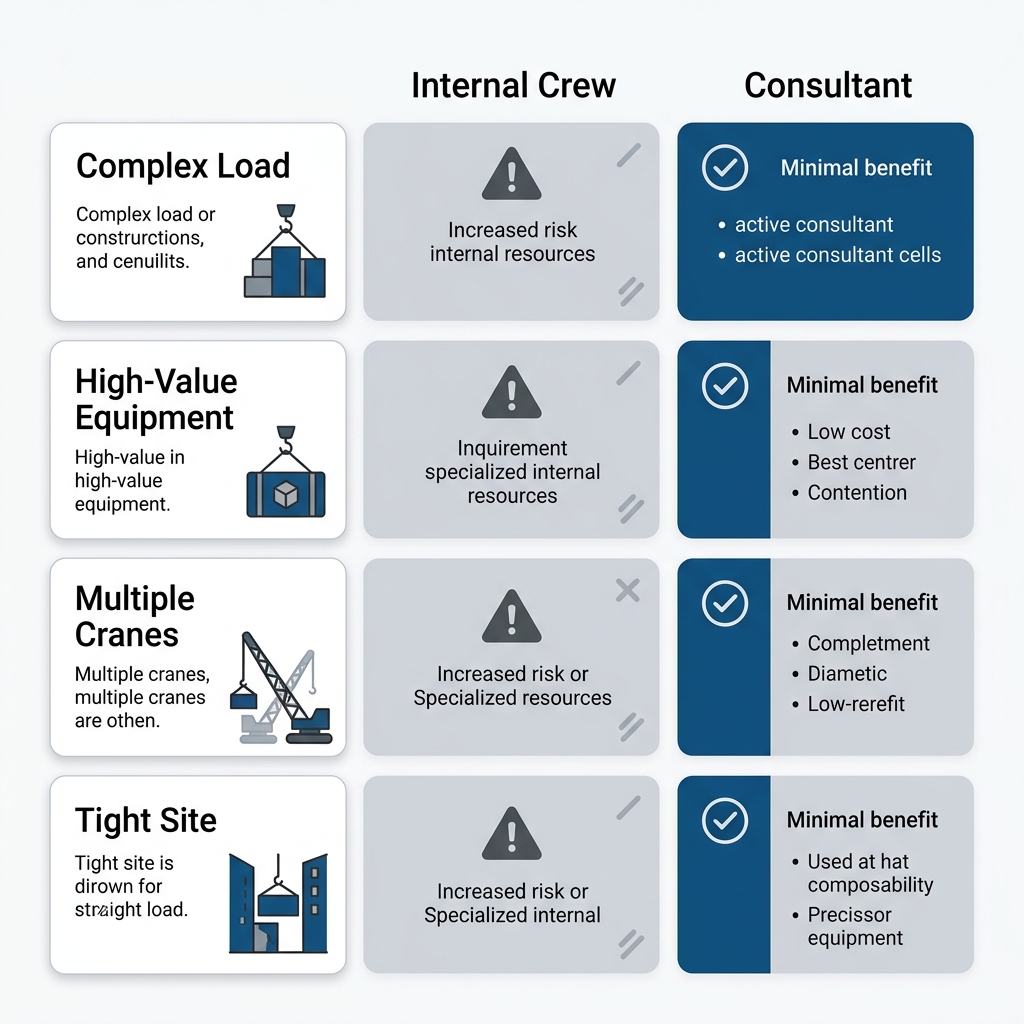
Critical lift decision matrix: internal crew vs rigging consultant
When your next project includes any of these critical-lift scenarios, relying solely on internal resources introduces unnecessary risk. A rigging consultant delivers certified lift plans, coordinated execution, and the peace of mind that comes from a thoroughly engineered approach. To learn more about our complete range of support, from operator staffing to full project oversight, explore our comprehensive industrial crane and rigging services.
Comprehensive Lift Planning and Compliance: The Rigging Consultant’s Process
When heavy loads must move, a rigging consultant brings systematic rigor from the first site walk to the final documented plan. At Crane Industry Experts, we approach every project with one clear goal: a lift that is safe, compliant, and repeatable. Our process aligns every load calculation, crane selection, and ground condition assessment with both project timelines and uncompromising safety standards. Safety isn’t just a standard — it’s our promise.
Developing a Critical Lift Plan
Developing a critical lift plan demands a disciplined sequence that begins long before a crane arrives on site. Our certified rigging consultant initiates each engagement with a thorough job walkdown, surveying access paths, overhead obstructions, and soil conditions. Next, we execute a detailed load survey to capture precise weight, dimensions, and the center of gravity–data that directly informs crane selection from manufacturer capacity charts. These calculations must account for dynamic factors such as swing acceleration and wind load, ensuring the chosen crane configuration operates well within rated limits. For a recent utility infrastructure crane project, our team validated load data against multiple crane configurations to determine the safest lifting approach.
Site conditions documentation follows load verification. We calculate ground bearing pressure per industry standards, determining when crane mats or cribbing are required to distribute the load and protect underground utilities. The final step translates all collected data into a written lift plan that specifies rigging configurations, sling angles, shackle capacities, and step-by-step execution procedures. As a critical lift specialist, our team ensures every plan component — from hook to foundation — is engineered for predictable performance.
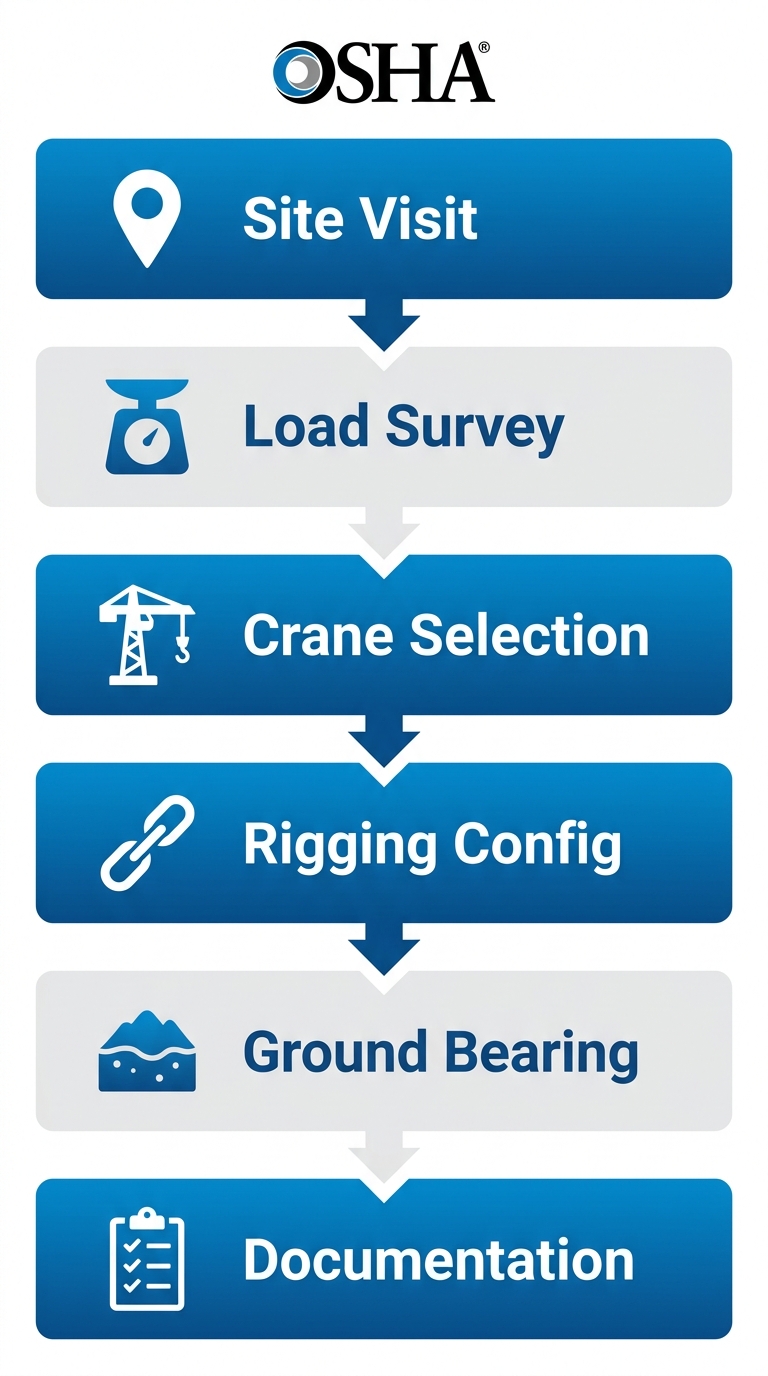
Comprehensive six-step critical lift planning process for rigging consultants
Ensuring OSHA and ASME Compliance
Regulatory compliance is not an afterthought — it is woven into every phase of our lift planning methodology. OSHA 1926.1400 mandates a documented critical lift plan for any operation exceeding 75 percent of a crane’s rated capacity or involving complex rigging, tandem lifts, or personnel hoisting. Our NCCCO-certified personnel conduct a pre-lift safety audit that cross-references every plan element against these federal requirements, verifying load chart accuracy, ground condition assessments, and operator qualifications.
ASME B30.5 establishes the safety standard for mobile cranes, while B30.9 governs slings and rigging hardware selection. With a rigging consultant guiding compliance, we inspect all below-the-hook equipment against these standards, confirming that sling configurations, working load limits, and connection points meet or exceed published thresholds. This dual-reference approach — OSHA for process and ASME for hardware — creates a compliance framework that construction managers, facility owners, and EPC teams can trust. As the Occupational Safety and Health Administration’s regulations stipulate, proper documentation validates that every critical decision was made before the lift begins.
Components of a Critical Lift Plan: Consultant Input
The following table highlights how a rigging consultant adds value to each essential lift plan component:
| Lift Plan Component | Description | Rigging Consultant Input |
|---|---|---|
| Load weight and dimensions | Precise measurement of the load | Validates against available crane charts |
| Center of gravity | Location of the load’s balance point | Calculates using 3D modeling or physical measurement |
| Crane capacity chart | Manufacturer’s load limits for specific configurations | Selects crane and configuration based on actual load |
| Rigging configuration | Slings, shackles, spreader bars, etc. | Determines safe rigging arrangement and capacities |
| Ground bearing pressure | Load imposed by crane on soil / mat | Calculates and recommends cribbing or matting |
Each row in this table represents a verification checkpoint where certified expertise prevents assumptions from becoming incidents. By validating manufacturer data against real-world conditions and calculating safety factors for every connection point, the consultant transforms a generic lift into a fully engineered event.
Leveraging 3D Lift Planning Software
Modern rigging engineering relies heavily on 3D simulation to bridge the gap between paper plans and real-world execution. Our team utilizes software platforms to model the complete lift path, including boom clearance arcs, obstacle proximity, and load rotation through every degree of swing. These visualizations allow a certified rigging professional to identify pinch points and spatial conflicts before they become job-site surprises.
The communication benefits are equally powerful. When all stakeholders — from the crane operator to the project manager — review an animated sequence of the planned lift, alignment improves immediately. Questions about sequencing, blind picks, and signalperson positioning are resolved during pre-lift meetings rather than during execution. With a rigging consultant driving the simulation, the team gains confidence that every aspect of the lift has been analyzed, visualized, and documented. Once the plan is developed and validated through 3D modeling, our Lift Directors carry that precision forward into on-site oversight, ensuring the safe execution that defines every project we serve.
Real-World Applications of Rigging Consulting for Complex Lifts
These consulting principles come to life in real-world applications, where the expertise of a rigging consultant transforms complex lifts from high-risk operations into controlled, successful events. At Crane Industry Experts, our team provides the planning and oversight necessary to navigate challenging projects. The following examples demonstrate how our rigorous approach to critical lift planning, crane selection, and on-site management ensures safety and compliance.
Calculating Ground Bearing Pressure for Heavy Lifts
A fundamental task for any lift planning consultant is calculating ground bearing pressure to prevent catastrophic soil failure. This engineering process begins with estimating the total crane load, which includes the weight of the lifted object, the rigging, and a portion of the crane’s own weight. Our specialists then determine the effective area of the crane’s outrigger pads or crawler tracks.
The ground bearing pressure is calculated by dividing the total load by this contact area. This figure is then meticulously compared against the soil’s bearing capacity, a value typically obtained from a project geotechnical report. According to the Occupational Safety and Health Administration (OSHA), it is critical to ensure the supporting surface is adequate for the equipment. This rigorous methodology is at the heart of critical lift planning, ensuring that every lift, from a prefabricated module to a heavy industrial component, starts on solid ground. This careful analysis is the only way to guarantee the stability needed for a safe and efficient lift.
Crane Selection and Lift Site Assessment
Selecting the right equipment is a cornerstone of rigging engineering. Our consultants evaluate site constraints such as overhead power lines, ground slope, and access width to determine a safe working zone. Using detailed load charts, we match the lift’s radius and weight requirements with a crane’s capacity, a process vital for avoiding overloading.
The following table illustrates how our certified lift directors approach equipment selection for different scenarios.
Crane Selection Guide for Complex Lifts
| Crane Type | Best Use | Consultant Considerations |
|---|---|---|
| Mobile hydraulic crane | Versatile on construction sites; quick setup | Check ground conditions, outrigger placement, load chart |
| Tower crane | High-rise construction; repetitive lifts | Evaluate foundation, wind speeds, tie-in points |
| Crawler crane | Heavy lifts on rough terrain | Assess mobility, ground pressure, boom length |
| Truck-mounted crane | Roadable; moderate lifts with quick travel | Verify stabilizers, axle loads, legal road weight |
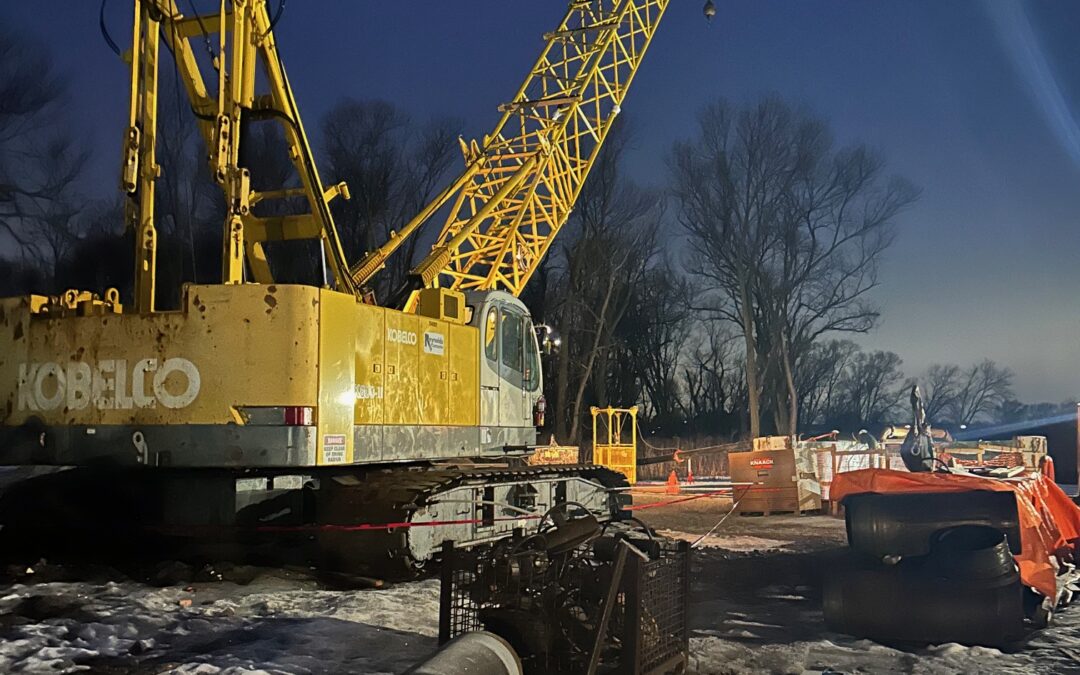
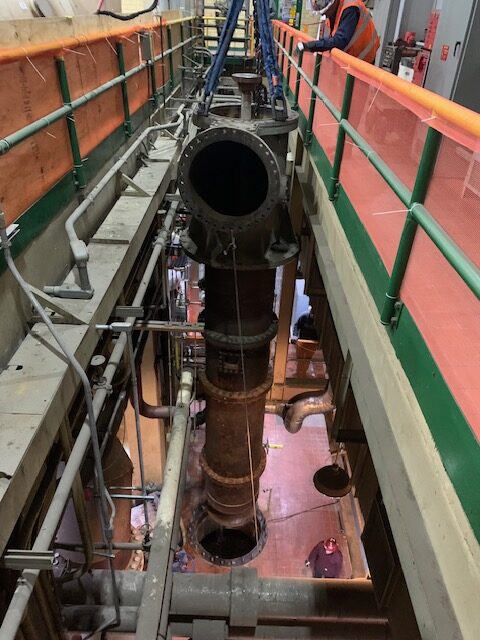
This decision-making process is critical. For a real-world example, explore our city well system crane case study in Sioux Falls. In that project, our team assessed the site and selected a crawler crane for its superior performance on the soft terrain, ensuring the safe setting of massive well components. A properly executed site assessment integrates this selection logic directly with the lift plan, mitigating risks before a load is ever rigged.
Job Walkdowns and On-Site Oversight
A job walkdown is where the plan meets reality. The rigging consultant‘s role during this phase is to verify that every condition matches the documented lift plan. We conduct a systematic checklist, confirming hazard identification, verifying the stability of laydown and setup areas, and ensuring all access routes are clear and secure.
On-site, our certified professionals coordinate directly with crane operators, signalpersons, and site superintendents. We review the lift plan against OSHA 1926.1400 standards, checking rigging equipment and ensuring the crane is assembled as engineered. For the aforementioned city well system project, our on-site oversight was instrumental in managing the complex sequencing of multiple heavy lifts. Safety isn’t just a standard — it’s our promise. This direct, in-person oversight transforms a theoretical plan into a controlled execution, preventing incidents and ensuring that every complex lift is performed correctly from start to finish.
Advanced Rigging Engineering and Heavy Lift Logistics
Advanced rigging engineering takes standard lifting operations to a higher level by applying detailed analysis to every phase of the job. As an experienced rigging consultant, we use that analytical mindset to de-risk complex lifts that general practices cannot handle. The goal of advanced rigging engineering is to confirm that every component — from the sling assembly to the ground bearing conditions — can withstand the calculated forces, so your project stays on schedule and fully aligned with OSHA and ASME requirements.
At the core of our approach is a suite of specialized analysis tools that model real-world conditions before a single piece of equipment arrives on site. 3D lift planning software simulates the full lift path, detects clashes with existing structures, and calculates dynamic loads under varying boom angles. On multi-crane lifts and tight-clearance sites — such as an operating industrial facility or a congested urban footprint — this capability is essential for critical lift planning. For custom fabricated gear, finite element analysis (FEA) evaluates stress distribution in components like lifting beams and spreader bars, particularly when the load has an unusual center of gravity or irregular shape. Complementing these predictive tools, load monitoring systems capture real-time data from load cells and integrate with crane instrumentation, allowing our lift directors to continuously verify that actual forces stay within the engineered envelope.
Frequently Asked Questions About Rigging Consultants
Here are answers to common questions about rigging consultants.
What is a rigging consultant and what do they do? A rigging consultant is a certified professional who plans, oversees, and ensures safe execution of crane and rigging operations. At Crane Industry Experts, our NCCCO-certified team applies critical lift planning and rigging engineering expertise to manage complex lifts across the U.S. — from job walkdowns through final placement.
When should a project hire a rigging consultant? Early in planning — as soon as you anticipate heavy, complex lifts or require additional safety and compliance expertise. Our team deploys rapidly nationwide, providing on-site oversight and detailed lift plans that align with OSHA standards.
What qualifications should a rigging consultant have? Look for NCCCO-certified riggers, Lift Director credentials, and extensive field experience. At Crane Industry Experts, our personnel hold Rigger Level I/II and Signal Person certifications, and we perform job walkdowns, safety audits, and lift plan reviews in full compliance with OSHA’s Cranes and Derricks Standard.
Elevate Your Next Project with Expert Rigging Consulting
Beyond equipment and operators, our expertise extends to strategic consulting. As a trusted rigging consultant, we deliver critical lift planning and rigging engineering to keep your project on track. Our NCCCO-certified team brings field experience and OSHA/ASME expertise, supporting projects coast to coast, from Indianapolis to Chicago and beyond.
Safety isn’t just a standard — it’s our promise. We deliver safe, professional, and reliable solutions. Our consulting expertise was recently applied on a complex power plant tandem lift project, where we ensured seamless execution from planning to completion.