Table of Contents
The Importance of Annual Crane Inspections for Compliance and Safety
While daily and monthly checks are essential, the annual inspection is the cornerstone of regulatory compliance. An annual crane inspection serves a dual role — it satisfies federal legal obligations and forms the backbone of a proactive safety program that protects personnel and equipment.
Federal law is explicit: the Occupational Safety and Health Administration (OSHA) mandates a complete annual inspection under 1910.179 for overhead cranes and 1926.1413 for mobile cranes. These OSHA crane inspection requirements are reinforced by industry consensus standards, particularly ASME B30.5 safety standards, which define detailed criteria for mobile cranes including load testing and structural examination. Together, these frameworks establish that an annual inspection is not optional — it is a legal obligation, and neglecting it carries fines and significant liability exposure.
Beyond compliance, an annual crane inspection delivers measurable operational value. Inspectors methodically examine load-bearing members for cracks, check for corrosion, and assess sheaves, wheel alignment, hydraulic systems, and wire rope. Early detection of defects — worn sheaves, frayed cables, or misaligned wheels — allows teams to schedule corrective work before a small issue becomes a catastrophic failure. This approach reduces unplanned downtime, extends crane service life, and preserves resale value. Documented inspection records provide proof of compliance during OSHA audits, demonstrating a verifiable commitment to safety.
A structured inspection program executed by certified professionals removes guesswork from compliance. We provide NCCCO-certified inspectors who work through detailed checklists aligned with OSHA and ASME standards, helping teams meet every regulatory benchmark. For companies seeking to streamline their annual inspection programs, experienced crane safety consultants provide the regulatory expertise needed to stay compliant. Safety isn’t just a standard — it’s our promise.
Understanding OSHA and ASME Requirements for Annual Crane Inspections
Building on the importance of routine crane inspections, understanding the specific OSHA and ASME requirements is essential for maintaining compliance. An annual crane inspection is the most thorough evaluation a crane undergoes, mandated by federal regulations and industry standards to keep lifting operations safe. OSHA crane inspection requirements under 29 CFR 1926.1413 establish the legal baseline, while ASME B30.5 safety standards provide the detailed procedural framework that guides inspection practices across the United States.
The following table summarizes the key differences as defined by OSHA and ASME:
| Inspection Type | Frequency | Scope | Who Can Perform |
|---|---|---|---|
| Frequent Inspection | Daily to monthly (per manufacturer/employer schedule) | Visual check of critical items: brakes, hooks, ropes, controls, safety devices | Operator or designated personnel |
| Periodic Inspection | 1-12 months (per OEM or regulatory schedule) | In-depth visual and functional check of all load-bearing components, often including disassembly | Qualified person (per OSHA/ASME definitions) |
| Annual Inspection | Once every 12 months (by anniversary date) | Comprehensive check of all structural, mechanical, electrical, and safety systems; load test may be required | Qualified person with documented training and experience (NCCCO preferred) |
OSHA mandates under 29 CFR 1926.1413 that employers ensure all cranes receive this annual inspection by a qualified person, and the standard requires that these inspections occur by the anniversary date of the crane’s last annual inspection, not by calendar year. The scope of an annual inspection is significantly broader than frequent or periodic checks, extending beyond visual assessments to include detailed examinations of structural welds, wire rope integrity, load moment indicators, and all safety devices.
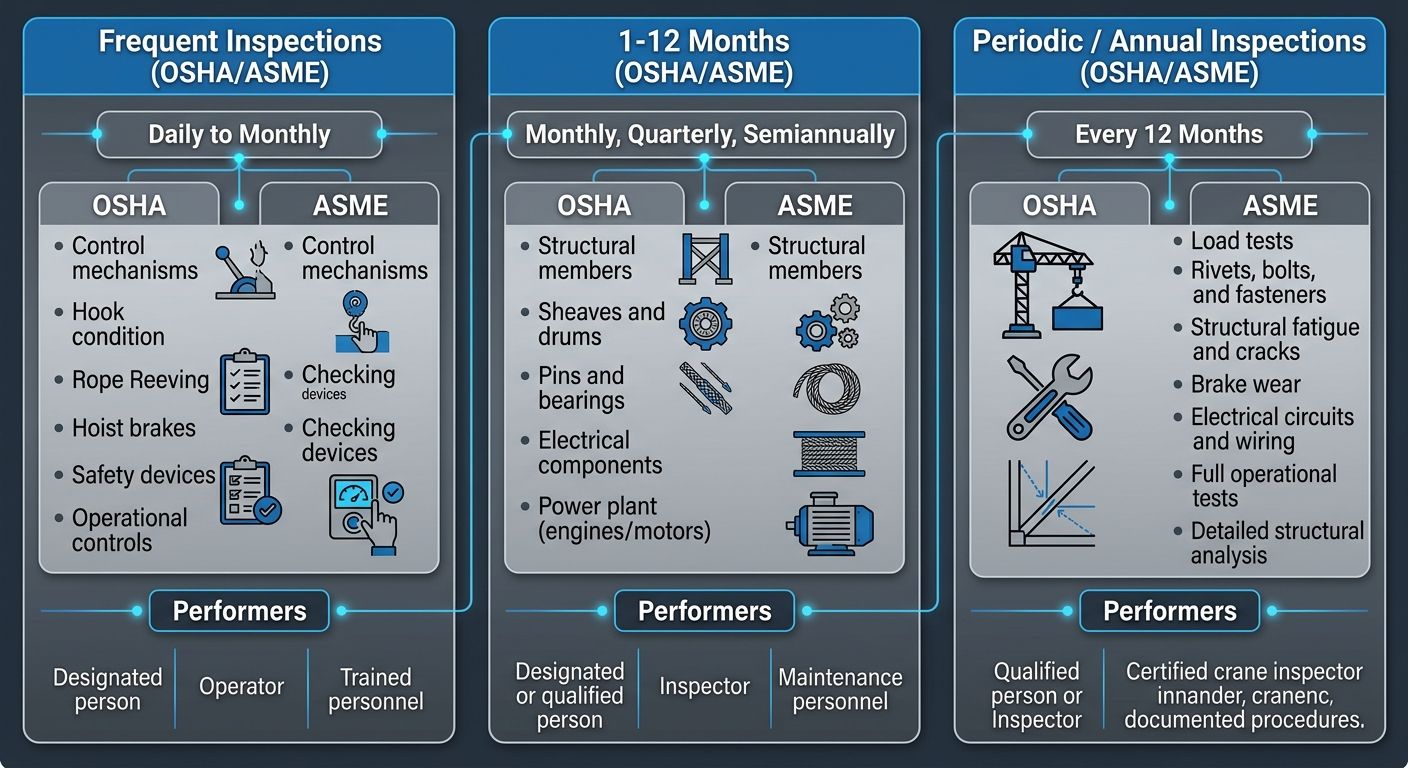
OSHA and ASME crane inspection frequency comparison
ASME B30.5 guidelines define the specific inspection procedures for mobile and locomotive cranes, establishing the industry standard that OSHA enforces. When an annual inspection is performed, every structural, mechanical, electrical, and safety system must be evaluated for wear, damage, or malfunction. In some cases, a load test may be required to verify the crane’s operational capacity and stability under working conditions. These comprehensive checks identify hidden defects that could lead to catastrophic failure if left undetected.
The qualifications required for performing an annual inspection are stringent. According to OSHA, the inspection must be conducted by a qualified person who possesses documented training and practical experience with the specific crane configuration. NCCCO-certified personnel are widely preferred for this role, as their certification demonstrates verified competency in crane inspection protocols and safety standards. Employers should prioritize using NCCCO-certified inspectors to ensure the inspection meets both the letter and intent of regulatory requirements.
Documentation is another critical obligation. Yearly inspection records must be maintained and readily available for OSHA review, detailing the inspection date, the inspector’s qualifications, and any identified deficiencies along with corrective actions taken. For a thorough understanding of your specific annual inspection obligations, working with a crane consultant can ensure full compliance with OSHA and ASME standards. With the requirements clear, the next section walks through the steps of an annual crane inspection.
What Components Are Checked During an Annual Crane Inspection?
An annual crane inspection is a comprehensive evaluation mandated by OSHA and ASME B30.5 safety standards, designed to identify any condition that could compromise safety or operational integrity. At Crane Industry Experts, our NCCCO certification ensures that every annual crane inspection we perform is conducted by qualified personnel who understand the critical nature of each component. This detailed examination goes well beyond a simple visual check, involving functional tests, precise measurements, and thorough documentation to confirm that every system performs safely under load. We leave no bolt, wire, or switch unexamined because safety isn’t just a standard — it’s our promise.
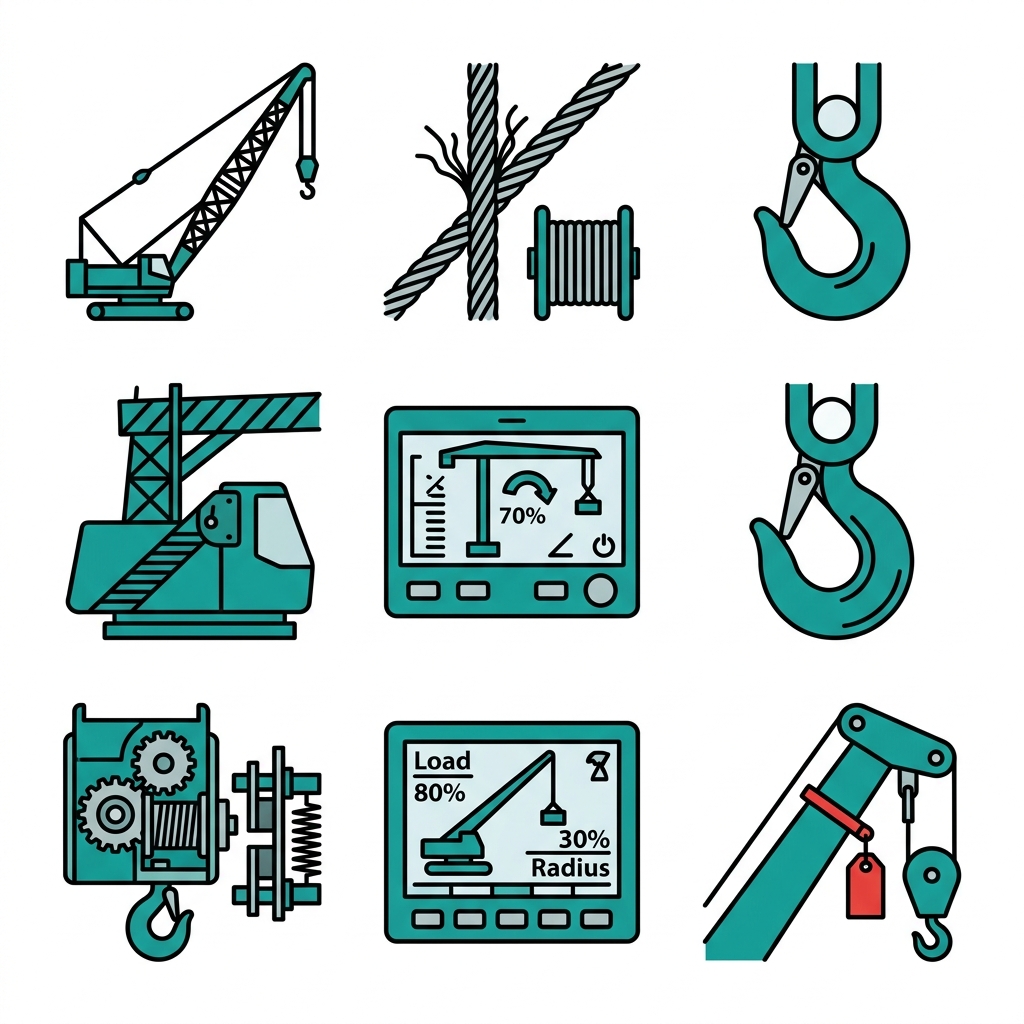
Annual crane inspection components icon set
Structural Integrity and Load Testing
The structural inspection forms the backbone of any yearly crane inspection, focusing on the crane’s main load-bearing members. Per ASME B30.5 section 5-1.3.7 and OSHA crane inspection requirements under 1926.1413, our technicians meticulously examine the boom, jib, turntable, and outriggers for cracks, deformation, corrosion, and weld discontinuities. This is a documented process where every finding is recorded. The load chart itself is also verified to be current, legible, and appropriate for the crane’s configuration. Functional load testing then validates the crane’s ability to handle its rated capacity safely. This part of the annual crane check confirms the structural integrity and stability of the entire machine, ensuring it can perform as engineered.
Wire Rope and Hoist Inspection
Wire rope is a critical component that demands a rigorous inspection, governed by both OSHA 1926.1413(a)(3) and ASME B30.5 section 5-1.3.4. Our inspectors run the full length of the rope, assessing its condition for any signs of damage. A thorough wire rope check includes employing non-destructive examination methods, such as magnetic particle inspection (MPI), visual inspection with a rope gauge, and measuring for any reduction in diameter. We look for broken wires, corrosion pitting, heat damage, and any sign of crushing or birdcaging to determine if the rope can remain in service.
Wire Rope Removal Criteria
The ASME B30.5 safety standards provide precise removal criteria which we strictly follow. A wire rope must be removed from service for conditions including, but not limited to: six or more broken wires in a single rope lay for rotation-resistant rope, evidence of significant corrosion pitting, a reduction of more than one-third of the original outer wire diameter, and any signs of heat damage or severe crushing.
Hoist and Brake System Checks
The load hoist and its brake systems are functionally tested at rated capacity to ensure they can hold the load without slipping, a requirement of ASME B30.5 section 5-1.3.9. We measure the brake lining thickness and compare it against original manufacturer specifications to guarantee sufficient material remains for safe operation. The clutch system is also inspected for wear and proper engagement. Every aspect of the hoist and brake system must pass this operational test, as its failure directly compromises load control and personnel safety.
Our comprehensive approach to an annual crane inspection integrates these checks into a single, documented report that meets both the ASME B30.5 and OSHA crane inspection requirements. By adhering to both the ASME B30.5 and OSHA standards, an annual crane inspection becomes more than a procedural hurdle; it is a fundamental risk mitigation practice.
Safety Devices and Operational Controls
The final critical phase of an annual crane inspection is the functional testing of all safety devices and operational controls. The Load Moment Indicator (LMI) is calibrated and tested to verify its accuracy is within 5% of the actual load, as dictated by ASME B30.5. We also test the anti-two-block system and swing brake to confirm they activate correctly and immediately halt motion. All operational controls–levers, pedals, and switches–are checked for proper, smooth response and clear labeling. Any failure in these systems requires immediate correction before the crane can be returned to service. Understanding these components is the first step to ensuring compliance and safety; we deliver safe, professional, and reliable crane and rigging solutions that support your project’s success — start to finish.
Scheduling, Documentation, and Record-Keeping for Annual Inspections
Once the inspection scope is understood, proper scheduling and documentation ensure that every annual inspection meets OSHA standards. At Crane Industry Experts, we know that meticulous planning and record-keeping are the foundation of a safe, compliant lift operation.
Anniversary Timing and Scheduling Best Practices
Federal regulations are clear: the annual crane inspection must be completed within 12 calendar months of the previous one. We treat this as a hard deadline, not a guideline. A yearly crane examination performed even one day late places your organization out of compliance and exposes it to liability. The anniversary date creates a natural, predictable rhythm for your safety program.
We also recognize that conditions on the ground can change. While 12 months is the maximum interval, earlier re-inspection is not only permitted but often prudent. OSHA crane inspection requirements allow for–and we strongly recommend–scheduling an additional inspection if a crane has been involved in an accident, undergone significant modifications, or experienced a near-miss. Changes in the operating environment, a prolonged period of disuse, or reassignment to a more demanding duty cycle are all valid triggers for a fresh set of eyes on the machine before it returns to work. Our team helps clients build these flexible scheduling protocols, ensuring that regulatory compliance and operational reality stay perfectly aligned.
Maintaining Compliance Documentation
Inspections without documentation are just observations. A complete and properly retained record is what proves compliance. OSHA-required crane checks call for a specific, seven-element paper trail. The documentation for every annual crane inspection must contain: the date of the inspection; the name and qualifications of the inspector; a clear crane identification, such as make, model, and serial number; the comprehensive inspection checklist used; all findings, both positive and negative; a description of any corrective actions taken to address defects; and the signatures of both the qualified inspector and an employer representative. This record transforms the inspection from an event into an asset that protects your organization for the life of the crane.
A common pitfall we see during our consulting engagements is a perfectly repaired crane with an imperfect record. Failing to document the corrective action taken to fix a defect is a frequent and costly violation. Even if the equipment is safe, an incomplete paper trail can lead to a citation.
Who Is Qualified to Perform Annual Crane Inspections?
Now that we understand why annual crane inspections are critical, let’s clarify who is qualified to conduct them. An annual crane inspection must be performed by a qualified person–a term precisely defined under OSHA and ASME B30.5 safety standards.
The Occupational Safety and Health Administration (OSHA) defines a “qualified person” under 29 CFR 1926.1401 as someone with knowledge, training, and experience to identify existing and predictable hazards and apply controls. This definition emphasizes the ability to recognize dangers and implement mitigating measures during an inspection. OSHA does not mandate a specific certification; however, NCCCO certification is widely recognized as acceptable evidence of qualification. Importantly, a crane operator’s experience alone does not automatically meet the OSHA crane inspection requirements–the individual must still demonstrate the defined competencies.
| Component / System | ASME B30.5 Requirement | OSHA 29 CFR 1926.1413 Requirement |
|---|---|---|
| Wire Rope | Annual complete inspection of length, broken wires, corrosion, reduction in diameter; removal criteria per section 5-1.3.4 | Inspect monthly or before each use; annual documented inspection per 1926.1413(a)(3); must follow manufacturer criteria or ANSI/ASME B30.5 |
| Hooks and Latches | Annual inspection for deformation, cracks, wear, latch operation; replace if threshold exceeded (B30.5 5-1.3.6) | Inspect before each use and ensure annual documented inspection per 1926.1413(a)(1)-(2); hooks with cracks or 15% twist must be removed |
| Load Hoist and Brake Systems | Annual functional test of hoist brakes, load-holding ability; brake lining thickness check (B30.5 5-1.3.9) | Brakes must be tested before use; annual documented inspection includes brake system condition (1926.1413(b)(3)) |
| Load Moment Indicator / Overload Systems | Annual calibration and function check per B30.5 5-1.3.12; verify accuracy to within 5% of actual load | Inspect and test per manufacturer specs and ensure proper operation before use (1926.1416(d)) |
| Structure & Welds | Annual inspection of boom, jib, turntable, outriggers for cracks, deformation, weld discontinuities (B30.5 5-1.3.7) | Annual documented inspection must include structural members (1926.1413(a)(2)(ii)(A)) |
Where OSHA focuses on hazard identification and control, ASME B30.5 places greater emphasis on documented training and the ability to identify specific equipment failures and corrective actions.
Under ASME B30.5 safety standards, a qualified person must have documented training and demonstrated proficiency to identify potential failures, risks, and necessary corrective actions for the specific crane being inspected. This standard strongly recommends certification programs like NCCCO to meet the documented competency expectations. A crane operator, even if experienced, must satisfy these documented criteria to legally perform an annual inspection. For crane owners, ensuring that inspectors meet both OSHA and ASME B30.5 safety standards provides a comprehensive safety assurance.
While OSHA does not mandate certification, NCCCO-certified personnel satisfy both OSHA and ASME criteria. At Crane Industry Experts, we employ NCCCO-certified inspectors who bring documented training and field experience to every inspection, reinforcing our safety-first commitment. Our NCCCO-certified inspectors serve all crane industry sectors nationwide, ensuring compliance across diverse applications. Contact us to schedule your next annual crane inspection. We deliver safe, professional, and reliable crane and rigging solutions that support your project’s success–start to finish.
Frequently Asked Questions About Annual Crane Inspections
What is an annual crane inspection?
An annual crane inspection is a comprehensive, documented examination of all critical components mandated by OSHA crane inspection requirements and ASME B30.5 safety standards. It verifies the crane’s structural integrity and safe operating condition.
How often is a crane required to be inspected?
OSHA mandates daily visual checks, monthly inspections, and a full annual inspection. The annual inspection is the most thorough, covering every structural and mechanical element.
Who is qualified to perform annual crane inspections?
OSHA requires a qualified person per 1910.179 and 1926.1400. Our NCCCO-certified teams provide nationwide crane operator services, including annual crane inspection in Indianapolis, and we believe safety isn’t just a standard — it’s our promise.
What does an annual inspection include?
A thorough evaluation of all structural, mechanical, and electrical systems. Our annual crane inspection includes load tests and documented reports kept on file, keeping you compliant.
Commit to a Culture of Compliance with Annual Inspections
An annual crane inspection is the bedrock of OSHA compliance under 29 CFR 1926.1412(d) for every crane used in construction, and ASME B30.5 safety standards require a qualified person to perform it. Fulfilling OSHA crane inspection requirements is only the beginning — a true culture of compliance transforms annual checks into proactive safety tools that uncover wear and prevent accidents before they disrupt the job. We reinforce this culture with safety audits and compliance support; our NCCCO-certified professionals guide your team in meeting regulatory expectations and embedding a continual improvement mindset into your operation.