Table of Contents
The NCCCO Lift Director: Certification, Role, and Career Path
One specialized role within the NCCCO certification framework is the lift director. An NCCCO lift director is the professional responsible for overseeing all aspects of a lift operation, a role distinct from crane operators, riggers, and signalpersons. While the operator manipulates the controls, the lift director plans and manages the entire process, from initial site assessment to final placement. Our organization emphasizes this distinction because effective oversight is fundamental to safe crane operations.
As outlined by the National Commission for the Certification of Crane Operators, the certification requires candidates to be at least 18 years old and have a minimum of two years of documented crane-related experience. The exam process includes a written test with 45 core questions and practical assessments integrated into specialty exams of 50 questions each, covering load charts and real-world scenarios. Certification remains valid for five years, after which a recertification process ensures continued competence.
The career path to becoming a certified lift director typically begins with hands-on experience as a crane operator or rigger. Many professionals, after gaining field proficiency, pursue additional training through industry providers like Industrial Training International to prepare for the NCCCO exams. Understanding the nccco certification importance is essential for appreciating the lift director role, as the credential verifies advanced knowledge of ASME P30.1 standards for lift planning. This progression often leads to advanced roles in safety management or project leadership. Understanding the lift director role is foundational for effective lift planning and compliance on every critical lift project.
Prerequisites and Path to Becoming an NCCCO Certified Lift Director
To become an NCCCO Certified Lift Director, you must meet clear prerequisites and follow a defined certification path. Achieving the nccco lift director credential demonstrates advanced competency in overseeing complex lifting operations and ensuring compliance with OSHA and ASME standards. We guide candidates through every step–from initial eligibility to final certification–ensuring they are fully prepared for the responsibilities of this critical role.
The prerequisites for the nccco lift director certification are specific and mandatory. First, candidates must hold a valid NCCCO CCO crane operator certification, such as the Mobile Crane Operator designation, before applying, as the Lift Director builds upon the foundational knowledge of safe crane operation. Additionally, the National Commission for the Certification of Crane Operators (NCCCO) requires at least two years of documented experience in lifting and hoisting operations. Candidates must also be at least 18 years old, comply with the NCCCO Code of Ethics and Substance Abuse Policy, and pass the required written examinations.
Once eligibility is confirmed, the certification path proceeds through several structured steps. Candidates submit an application form to the NCCCO, provide proof of their current CCO certification and verifiable experience, and pay the applicable fee. For exam preparation, recognized providers like Industrial Training International (ITI) offer comprehensive courses covering lift planning, load chart interpretation, rigging principles, signaling procedures, and the ASME P30.1 standard for lift planning. The written examination itself is a multiple-choice assessment covering lift director responsibilities, federal regulations, and the development of a critical lift plan. It includes a Core Exam of 45 questions with a 60-minute time limit, and a Specialty Exam for either Mobile or Tower Cranes, consisting of 50 questions with a 90-minute limit. Practical assessment is integrated through scenario-based questions that rely on real-world lift plans and crane load charts. After passing all exams, certification is granted and is valid for five years. Recertification requires completing continuing education activities or re-examination within the 12 months prior to expiration.
The following table clarifies how the certified lift director role differs from other common NCCCO-certified positions.
| Role | NCCCO Certification Required | Primary Responsibility |
|---|---|---|
| Lift Director | Yes (Lift Director specific) | Overall lift planning and execution, site oversight |
| Crane Operator | Yes (CCO) | Safe crane operation |
| Rigger | Yes (Rigger Level I/II) | Load rigging and securement |
| Signalperson | Yes | Direct crane operators during lifts |
As the table illustrates, the Lift Director certification is distinct and additional to operator, rigger, or signalperson credentials, focusing specifically on overall lift management rather than the hands-on execution of individual tasks.
Once certified, the Lift Director assumes critical lift planning and oversight duties covered in the next section. For comprehensive certified lift director services with nationwide rapid mobilization, contact our team.
NCCCO Lift Director Written Exam and Certification Requirements
Achieving the status of an NCCCO Lift Director is a significant undertaking that verifies an individual’s ability to lead complex crane operations safely. The certification process, governed by the National Commission for the Certification of Crane Operators (NCCCO), ensures that every lift is planned and executed under the guidance of a qualified professional. Our team at Crane Industry Experts values this credential as a cornerstone of project safety and operational excellence.
Written Exam Structure and Core Topics
The NCCCO Lift Director written exam consists of approximately 75 multiple-choice questions, with candidates given a two-hour time limit to complete the test. According to the NCCCO, the exam integrates practical skill evaluation through scenario-based questions that use real-world lift plans and load charts. Applicants must also hold a valid NCCCO Operator (CCO) certification or meet equivalent prerequisites before challenging the exam.
The exam content spans five core categories, weighted to reflect their importance in safe lift execution:
| Exam Topic | Focus Area | Typical Weight |
|---|---|---|
| Regulatory Knowledge | OSHA, ASME, local codes | 25% |
| Load Chart Interpretation | Selecting lifting capacity based on configuration | 20% |
| Lift Planning | Step-by-step lift procedure, critical lift criteria | 30% |
| Risk Assessment | Identifying hazards, mitigation strategies | 15% |
| Communication and Coordination | Signal person, crew roles, pre-lift meetings | 10% |
Given that Lift Planning and Risk Assessment account for the largest portions of the exam, candidates should dedicate substantial study time to developing detailed critical lift plans and understanding the ASME P30.1 standard for lift planning. The communication and coordination segment reinforces that a lift director’s leadership extends beyond technical knowledge, requiring clear, structured responsibilities for every crew member.
Recertification and Maintaining Your Credential
NCCCO Lift Director certification remains valid for five years from the date of issuance. To maintain active status, certificants must either complete 1.5 Continuing Education Units (CEUs) through NCCCO-approved courses or retake the written exam. The NCCCO requires that all recertification tasks be completed within the 12 months immediately preceding the expiration date.
Crane Industry Experts ensures that every lift director on our team stays current. We monitor renewal deadlines and encourage ongoing education so that our professionals are always prepared to uphold the highest safety standards. Safety isn’t just a standard — it’s our promise, and it begins with personnel whose certifications never lapse.
Preparing for the Lift Director Exam
Successful preparation demands a structured approach. We recommend starting with the official NCCCO Lift Director handbook, the authoritative resource that mirrors the exam blueprint. Industrial Training International (ITI) offers a comprehensive Lift Director training course that aligns directly with exam topics, while Train for the Crane provides focused practice exams that help candidates gauge their readiness.
Our lift directors have found that combining the NCCCO handbook with real-world lift planning scenarios accelerates comprehension. Focus the majority of your study time on lift planning and risk assessment, as these topics carry the most weight. All of our lift directors maintain current NCCCO certification and undergo regular training to keep their skills sharp.
For organizations that need immediate, fully qualified oversight, our certified lift director services provide experienced professionals ready to manage your critical lifts from start to finish. After achieving NCCCO certification, a lift director is equipped to lead complex lifts. Our certified lift director services put that expertise to work on your site.
Lift Director Responsibilities: Critical Lift Plans and On-Site Oversight
While all lifts require planning, certain lifts demand additional oversight from a certified lift director. An NCCCO lift director brings specialized expertise to critical lifts, ensuring compliance with ASME P30.1 and OSHA standards while safeguarding personnel and assets.
What Makes a Lift “Critical”?
According to ASME P30.1 and OSHA 1926 Subpart CC, a lift is deemed critical when it meets any of several high-risk criteria. Common triggers include lifts exceeding 75% of the crane’s rated capacity (some configurations allow up to 90%), operations involving multiple cranes (tandem lifts), handling hazardous materials, hoisting personnel, or moving loads valued over $1 million. Lifts over live facilities or in congested environments also qualify. When any of these conditions exist, a formal critical lift plan must be developed before work begins. Rigging Force guidelines reinforce that exceeding the 75% capacity threshold automatically requires the rigorous documentation and oversight of a critical lift plan, while ITI training materials stress the extra coordination needed for multi-crane lifts.
To illustrate the differences, the following table compares standard and critical lift plan requirements.
| Aspect | Standard Lift Plan | Critical Lift Plan |
|---|---|---|
| When Required | Routine lifts under normal conditions | Lifts exceeding 75-90% capacity, multiple cranes, hazardous environments, or high-value loads |
| Documentation | Basic lift permit or checklist | Detailed engineering analysis, rigging study, contingency plans |
| Approval | Site supervisor or foreman | Lift Director, project engineer, and often client representative |
| Review Frequency | Once before lift | Reviewed before each shift if project is extended; updated if conditions change |
| Pre-lift Meeting | Optional or brief | Mandatory, with all crew members present, review plan and emergency procedures |
Data sourced from ITI critical lift training materials and Rigging Force.
As the comparison demonstrates, critical lifts demand far more thorough preparation, documentation, and oversight than routine operations. The Lift Director’s involvement in approval and the mandatory pre-lift meeting reflect the heightened safety stakes and the need for coordinated, real-time decision-making.
Understanding these requirements is the foundation for safely executing any complex lift. Visualizing the contrast helps project teams appreciate why certified lift directors are essential for high-risk operations.
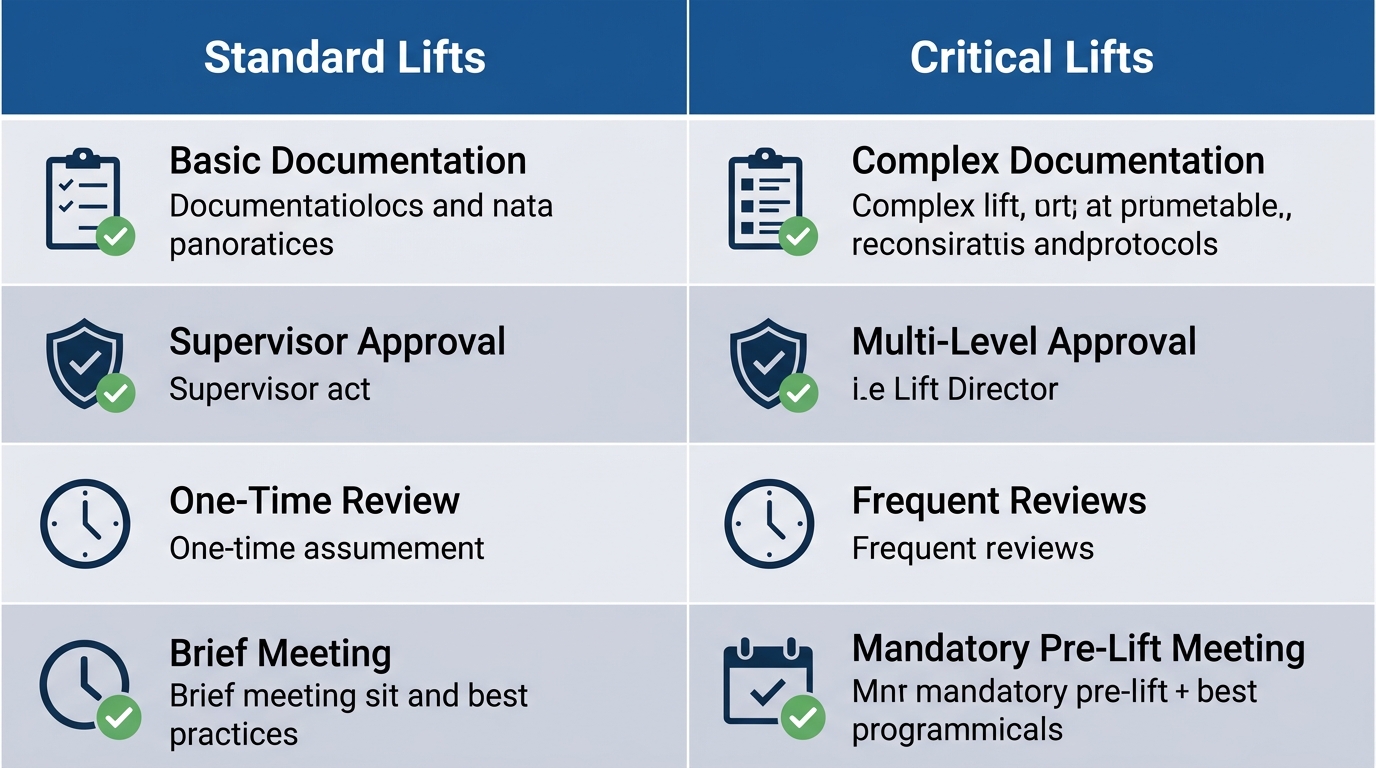
Comparison of standard and critical lift planning requirements
With a clear definition of critical lifts established, the next focus is on building and executing a critical lift plan.
Building and Executing a Critical Lift Plan
A critical lift plan must detail every facet of the operation. It begins with precise load weight calculations and the selection of the appropriate crane configuration, including boom length and jib where required. Rigging selection must specify slings, shackles, and hardware rated for the load, and site conditions–wind speed, ground bearing capacity, and proximity to obstructions–are thoroughly evaluated. Contingency procedures for equipment failure or unexpected load shifts are mandated. The lift director signs off on the completed plan and presents it during a mandatory pre-lift meeting attended by all crew members, including the operator, riggers, and signalperson. For projects spanning multiple shifts, the plan is reviewed before each shift and updated whenever weather, ground, or equipment conditions change. Our lift planning services incorporate every one of these elements, drawing on ASME P30.1 requirements and NCCCO-certified expertise to produce a fully validated lift plan. Rigging Force practitioners emphasize that the pre-lift meeting is the opportunity to clarify roles and emergency procedures, ensuring that everyone understands the plan before the first pick.
The Lift Director’s Role in Site Safety Oversight
Once operations begin, the lift director provides continuous on-site oversight to maintain safety and compliance. Key responsibilities include:
- Monitoring adherence to the approved critical lift plan throughout each shift.
- Conducting daily safety audits to verify that all equipment, rigging, and personnel certifications remain current.
- Adjusting lift parameters in real time when site conditions change, such as wind speed or ground settlement.
- Coordinating clear communication between the operator, riggers, and signalperson to prevent signal confusion.
- Exercising the authority to halt any lift that deviates from the plan or poses an immediate safety risk.
An NCCCO lift director brings the specialized training required to enforce these protocols effectively. Our lift director staffing service deploys certified professionals who integrate seamlessly into your project, ensuring that every critical lift meets ASME P30.1 and OSHA standards from start to finish.
With these responsibilities understood, the next step is obtaining lift director certification.
ASME P30.1 Compliance and Lift Director Oversight
Under ASME P30.1, the role of a lift director carries more stringent requirements than OSHA’s baseline rules, and a certified NCCCO lift director is indispensable for ensuring full compliance on every project. This standard elevates safety, planning, and documentation across all lifts–not just critical ones.
ASME P30.1 explicitly defines the lift director’s responsibilities, requiring a written lift plan and thorough risk assessment for every lift–routine or complex. OSHA only demands such plans for critical lifts, leaving other lifts with minimal oversight. Our NCCCO-certified lift directors are trained to meet these heightened documentation and planning standards, providing a clear compliance advantage.
The table below compares ASME P30.1 and OSHA crane regulations, underscoring why ASME P30.1 sets a higher bar for lift director oversight.
| Requirement Area | ASME P30.1 | OSHA (29 CFR 1926.1400) |
|---|---|---|
| Lift Director Definition | Clearly defined role with specific duties | Recognized but less prescriptive |
| Planning Documentation | Mandates written lift plan for all lifts, with detailed risk assessments | Requires lift plans for critical lifts only; general plan can be verbal |
| Personnel Responsibilities | Lists responsibilities for lift director, operator, rigger, signalperson | Outlines operator and signalperson duties; lift director role inferred |
| Compliance Documentation | Lift director must document training, certification, lift records | Employer must maintain certification records; less specific on lift plans |
These requirements directly influence project safety and liability. Under ASME P30.1, the lift director must confirm that all personnel are qualified and that certified rigger services are engaged for every lift involving complex rigging configurations. The standard’s mandatory documentation of training, certifications, and lift records creates a robust audit trail–something OSHA does not demand for non-critical lifts. According to the NCCCO, the lift director certification program is designed for these duties, while training resources from Industrial Training International (ITI) and Becht Engineering provide the technical foundation. By meeting ASME P30.1, owners and contractors reduce the likelihood of incidents and demonstrate a proactive commitment to safety beyond the OSHA baseline.
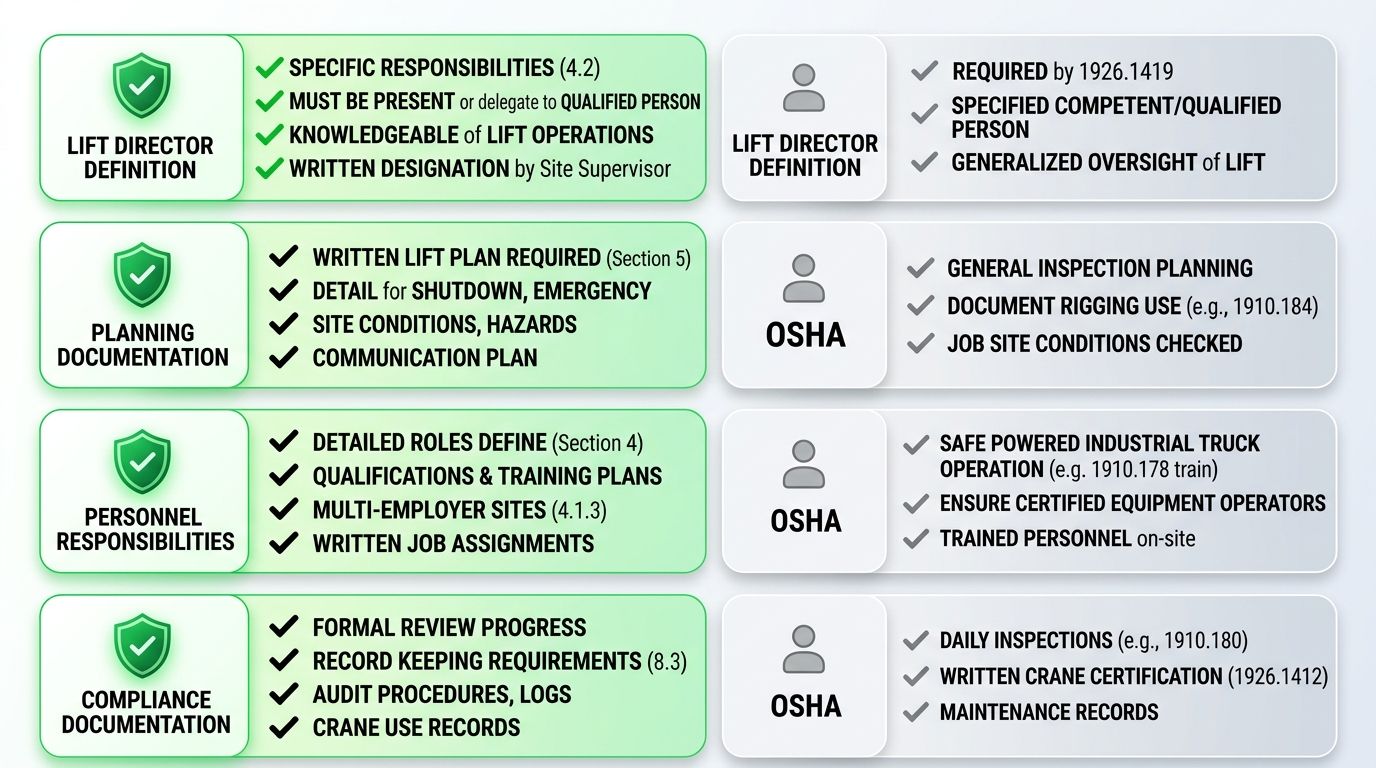
ASME P30.1 versus OSHA: crane regulation comparison infographic.
As a nationwide provider of NCCCO-certified lift director services, Crane Industry Experts supplies the certified personnel needed to meet ASME P30.1 requirements on any jobsite. Our lift directors develop comprehensive lift plans, oversee rigging operations, perform job walkdowns, and maintain the detailed documentation the standard demands. Whether your project calls for a critical lift plan for a single pick or ongoing oversight for a multi-crane spread, our team integrates seamlessly to uphold safety–because “Safety isn’t just a standard; it’s our promise.”
Ready to bring certified lift director expertise to your next project? Contact us to discuss your requirements and ensure full ASME P30.1 compliance.
Frequently Asked Questions About NCCCO Lift Director Certification
Here are answers to common questions about NCCCO Lift Director certification.
What is an NCCCO Lift Director certification?
An nccco lift director credential qualifies professionals to plan and oversee crane lifts, especially those with complex safety requirements. It demonstrates expertise in developing a critical lift plan that meets regulatory standards.
Who needs this certification and what are the prerequisites?
According to NCCCO, candidates typically need a valid Rigger Level II certification and documented lift-planning experience before testing. This certification is essential for anyone responsible for directing crane operations.
What topics does the lift director exam cover?
The exam tests knowledge of lift planning, load chart interpretation, site hazard assessment, and ASME P30.1 guidelines. It uses scenario-based written questions that evaluate practical decision-making skills for real-world lift scenarios.
How long is it valid and how do I renew it?
NCCCO requires recertification every five years. Professionals can renew by passing a written exam or completing continuing education. Crane Industry Experts employs certified lift directors who maintain these active credentials for every project.
Building Safer Crane Operations with Certified Lift Directors
NCCCO-certified lift directors are the backbone of safe crane operations, verifying load capacities and coordinating every phase. The NCCCO certification confirms their mastery of load charts, crane capacities, rigging, and site safety protocols. Training from Industrial Training International (ITI) gives them the skills to develop critical lift plans that align with ASME P30.1. On complex lifts, these directors supervise all activities and have the authority to halt any operation that threatens safety. By deploying certified crane personnel staffing, we place a qualified lift director on your project to manage risk and maintain compliance.