Table of Contents
The Lift Director: A Key Role in Lifting Operations
The Lift Director is a key role in any lifting operation. Unlike a Signal Person or Rigger who handle specific, hands-on tasks, the Lift Director oversees the entire lift from start to finish, ensuring every element works together safely. Our team of Lift Directors develops critical lift plans that detail every step of the operation, from crane selection to load calculations. They ensure full compliance with OSHA 1926.1400 and related standards, particularly 29 CFR 1926.1412(d)(8) which requires a designated Lift Director for all lifts. Additionally, they supervise the lift crew during execution to maintain safety and efficiency. Without a qualified lift director, even a straightforward lift can introduce unnecessary risk, jeopardizing worker safety and project timelines.
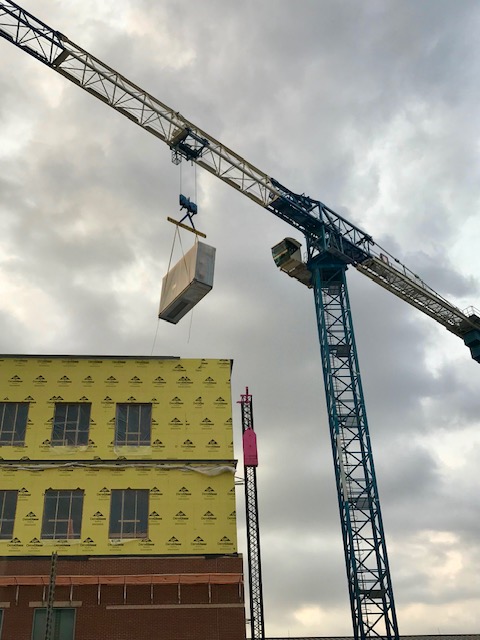
OSHA mandates that a competent, designated Lift Director must be in place for every crane operation. To demonstrate that competency, our NCCCO-certified personnel hold relevant certifications and stay current with ASME P30.1 standards. This leadership is especially critical on complex projects like the hospital construction lift director project in Avon, Indiana, where precise coordination ensured a safe, on-schedule lift. This role becomes even more vital when executing critical lifts, which require a detailed critical lift plan and often ASME P30.1 compliance and oversight.
Defining the Lift Director: Responsibilities and Legal Requirements
While a solid lift plan is essential, the execution depends on the person in charge: the Lift Director. A lift director is the designated competent person who holds overall authority and responsibility for lifting operations, as defined by OSHA 29 CFR 1926.1400. This role ensures that every crane lift — from standard hoists to complex critical lifts — is planned, coordinated, and carried out safely and in compliance with all applicable regulations. At Crane Industry Experts, we know that the lift director in any operation serves as the single point of accountability, bridging planning and field execution.
Responsibilities
The lift director’s core duties center on developing and approving the lift plan, which must incorporate ASME P30.1 standards and account for site-specific variables. For elevated risk scenarios, the director is responsible for creating a critical lift plan that addresses personnel hoisting, tandem lifts, or loads near power lines. Before work begins, the director conducts thorough risk assessments and confirms that all equipment is properly configured and that personnel — operators, signalpersons, and riggers — are qualified. To ensure every lift is safe, the Lift Director must verify all rigging personnel hold appropriate credentials, such as certified rigger levels, as part of the lift plan review. The director also oversees communication protocols and pre-lift meetings, maintains the lift plan documentation, and manages incident reporting in line with regulatory requirements. While operators and signalpersons execute defined functions, the person directing the lift retains ultimate authority for the overall lift’s safety and compliance. For critical lifts, this authority includes enhanced approval obligations and additional oversight.
Legal Requirements
Federal regulations under OSHA 29 CFR 1926 Subpart CC establish the foundational legal framework for lift directors in the United States. According to the Occupational Safety and Health Administration (OSHA), the lift director must be a competent person who meets defined experience and knowledge criteria. Beyond federal standards, many states impose stricter requirements. For example, the Washington State Department of Labor & Industries (L&I) enforces additional crane safety rules through WAC 296-155, including mandatory registration of cranes and specific lift director qualifications. In Washington, the lift director in that jurisdiction must comply with both federal OSHA and state-specific documentation and training mandates. In all cases, the Lift Director must hold appropriate certification — such as the NCCCO Lift Director certification — or demonstrate equivalent competence through verified experience. Our own lift directors are NCCCO-certified professionals who navigate these layered requirements for projects nationwide. Adherence to ASME P30.1 is also a legal expectation in many jurisdictions, as it is often referenced in OSHA and state regulations.
The Lift Director’s role is not only about coordination; it is a legal commitment to safety. Safety isn’t just a standard — it’s our promise. Understanding the responsibilities and legal requirements sets the stage for the training and certification paths that qualify a Lift Director.
The Certified Lift Director: Qualifications, Training, and Certification Path
Now that you understand the lift director’s role, here is the path to becoming certified. The following table breaks down the responsibilities, certification needs, and scope of authority for each lifting team member, underscoring why a dedicated lift director is essential.
| Role | Core Responsibilities | Certification Required | Can Perform Lift Director Duties? |
|---|---|---|---|
| Lift Director | Oversees entire lift operation, develops lift plan, coordinates personnel, ensures compliance | NCCCO Lift Director certification or equivalent | Yes |
| Crane Operator | Operates the crane, follows lift plan, communicates with lift director | NCCCO Crane Operator certification | No (unless designated as lift director for the specific lift) |
| Rigger (Level I/II) | Attaches loads, inspects rigging gear, assists in lift execution | NCCCO Rigger certification | No |
| Signalperson | Provides hand/radio signals to crane operator, ensures clear communication | NCCCO Signalperson certification | No |
Only the lift director is authorized to develop the lift plan and coordinate all personnel, highlighting the rigorous qualification path required.
NCCCO Certification Requirements
To earn a lift director credential, candidates must meet clear eligibility benchmarks set by the National Commission for the Certification of Crane Operators (NCCCO) and align with OSHA requirements. The Occupational Safety and Health Administration mandates that a qualified person be designated in writing before a critical lift — a role that the certified lift director fulfills.
- At least three years of crane-related experience in a role such as crane operator, rigger, or signalperson, or an equivalent combination of education and hands-on work.
- Documentation of formal training hours that cover lift planning, load charts, site coordination, and OSHA/ASME regulations.
Candidates then pass two exams:
- A 100-question written test that evaluates load chart interpretation, lift planning, OSHA/ASME standards, and site communication; a score of 80% or higher is required.
- A practical demonstration where the candidate plans a lift, conducts a pre-lift meeting, communicates with the operator and crew, and maintains load control in a real-world scenario.
Achieving the lift director certification confirms that the individual can manage complex lifts while meeting all regulatory obligations.
Training Pathways and Experience Prerequisites
We recommend a structured combination of classroom training and field mentorship. Many candidates start with the NCCCO’s preparatory courses, supplemented by OSHA 10- or 30-hour construction safety programs and industry-recognized resources from the National Crane Safety Council. These programs build deep knowledge of lift planning standards such as ASME P30.1 and reinforce safety protocols.
Hands-on experience is equally important. Before applying, candidates should log at least 1,500 hours of supervised field work under a certified lift director, ideally across roles like crane operator, rigger, or signalperson. This ensures practical competence in interpreting a critical lift plan and coordinating multi-personnel operations. For complex projects, such as our presidential library rigging consultation, a certified lift director is essential to ensure compliance and safety. Employers typically look for proof of current certification and a log of at least five supervised lifts per year, so building this record early pays dividends.
Maintaining Certification and Recertification
Once earned, a lift director’s certification must be kept current. NCCCO requires recertification every five years. Professionals can meet this by passing the written and practical exams again or completing 16 hours of continuing education units (CEUs) that are directly relevant to lift planning and safety. Maintaining a personal log of supervised lifts — a minimum of five annually — reinforces the credential’s validity and satisfies many employer requirements.
We stay committed to the principle that safety isn’t just a standard — it’s our promise. By ensuring our team members remain current with NCCCO standards, we deliver safe, professional, and reliable crane and rigging solutions that support your project’s success — start to finish. Our NCCCO-certified lift directors are ready to elevate your next critical lift.
Lift Director in Action: Critical Lift Planning and Site Oversight
Now that we’ve established the lift director’s qualifications, let’s see how those skills translate to real-world critical lift oversight. At Crane Industry Experts, our NCCCO-certified lift directors deliver safe, professional, and reliable solutions that support your project’s success — start to finish. The table below contrasts standard and critical lifts to frame the elevated responsibilities.
| Aspect | Standard Lift | Critical Lift |
|---|---|---|
| Definition | Routine lift that does not exceed defined thresholds | Lift exceeding specific weight or risk thresholds, or involving special circumstances |
| Regulatory Requirements | General OSHA crane standards apply | Must meet OSHA’s Subpart CC requirements + critical lift plan |
| Documentation Needed | Basic lift data may be recorded | Formal critical lift plan with load calculations, engineering review, and approval signatures |
| Lift Director Role | May be designated but not always required | Required on site; must supervise all phases |
| Pre-lift Activities | Standard pre-lift meeting and inspection | Full job walkdown, ground bearing pressure analysis, and contingency planning |
Developing a Comprehensive Critical Lift Plan
Developing a comprehensive critical lift plan is the cornerstone of safe execution. The process begins with detailed load calculations that account for the lifted object’s weight plus all rigging hardware, ensuring the crane’s capacity is never exceeded. Our NCCCO-certified lift directors then select an appropriate crane based on the load chart, verifying that it can operate within the required radius and height. Site evaluation follows, analyzing soil bearing capacity under the crane’s outriggers, clearance from structures, and space constraints. At Crane Industry Experts, we require an independent engineering review for every critical lift plan, which confirms the plan’s integrity. Once the review is complete, the plan receives formal approval signatures from the lift director, project manager, and safety representative. Our lift directors also integrate risk mitigation measures into the plan, specifying procedures for high-wind delays, power line proximity alarms, and emergency stop protocols. By following ASME P30.1’s structured framework, we ensure nothing is overlooked. Safety isn’t just a standard — it’s our promise, and our critical lift plans reflect that commitment. This documented plan, developed in accordance with OSHA Subpart CC and ASME P30.1, is kept on site for the lift’s duration, providing a clear compliance record and operational roadmap.
Conducting Job Walkdowns and Hazard Assessments
Pre-lift job walkdowns are where theory meets reality. Before any critical lift, our lift directors perform a rigorous site inspection, evaluating ground conditions such as compaction, slopes, and the presence of subsurface utilities. They identify overhead obstructions like power lines and structures, utilizing proximity alarms and insulated barriers as mitigations. Weather is continuously monitored; if wind speeds exceed the crane’s limits or lightning threatens, the lift is postponed without question. The walkdown also includes a mandatory personnel briefing to ensure every team member understands hand signals, radio channels, and their role. Ground bearing pressure analysis confirms that the soil can support the crane’s full load plus dynamic forces. While OSHA mandates a safe work environment, state-specific programs like those from the Washington State Department of Labor & Industries may require documented ground bearing pressure calculations for critical lifts, adding an extra layer of accountability. By systematically addressing each hazard, we transform the field conditions into a controlled environment aligned with the approved plan. If the walkdown reveals variables not considered in the original critical lift plan, our lift director immediately updates the documentation and re-verifies load charts. This adaptive approach keeps safety paramount.
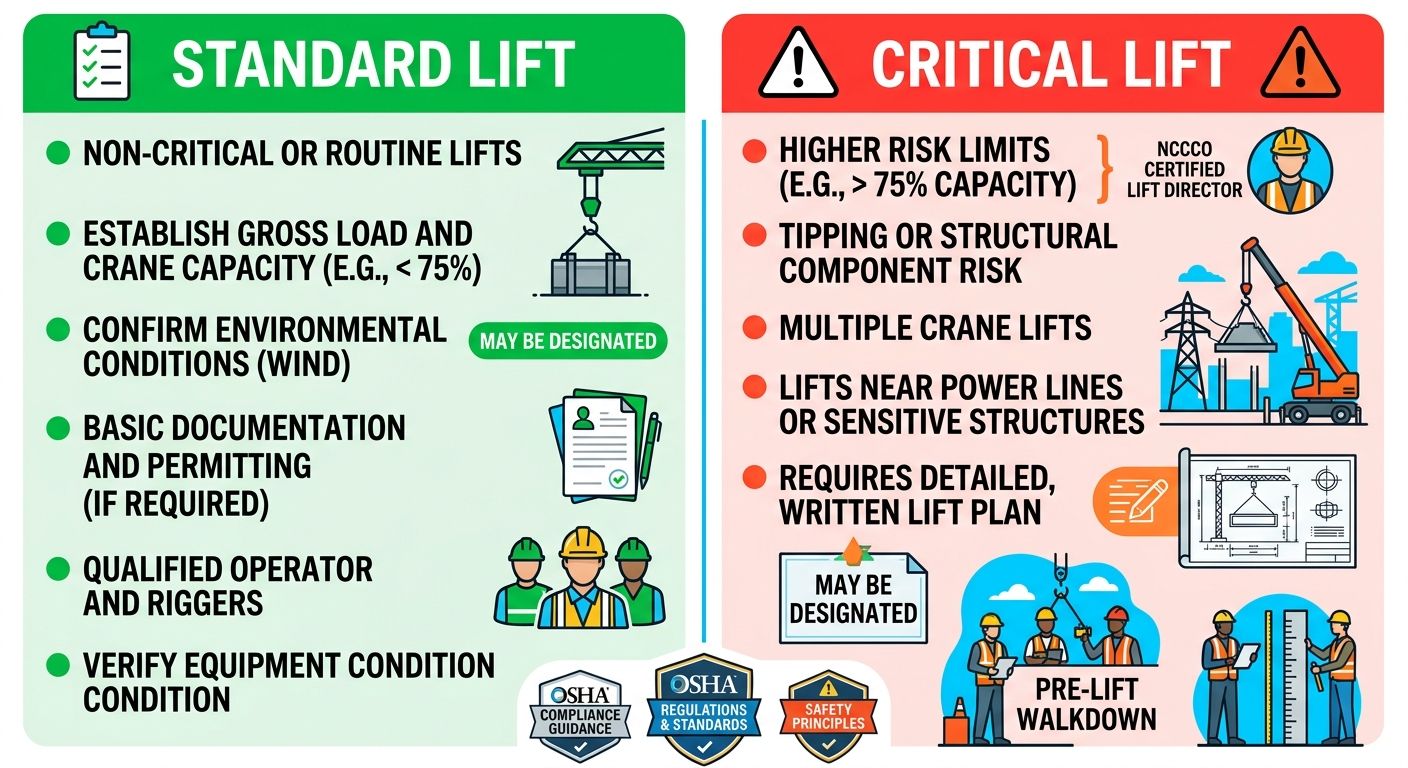
Standard vs Critical Lift comparison with OSHA compliance featuring green and red columns
Coordinating Multi-Crane and Complex Lifts
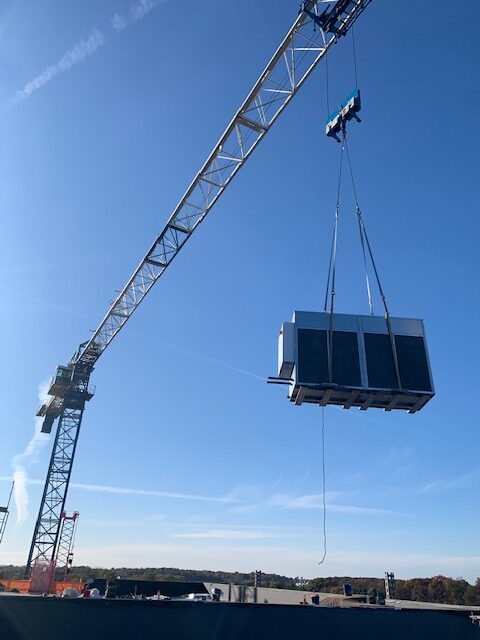
When a project requires multiple cranes, the lift director’s coordination skills become critical. A single certified lift director oversees all crane movements, establishing common communication channels such as unified radio frequencies and standardized hand signals. Synchronized load charts ensure that no individual crane exceeds its rated capacity, even as loads shift during the pick. Contingency plans address potential single-crane failure, providing backup procedures to safely land the load. For example, during a power plant outage rigging project, the lift director must manage communication across multiple cranes and coordinate lift sequencing to meet tight shutdown schedules. The lift director maintains stop-work authority if any crane deviates from the plan. At Crane Industry Experts, we’ve orchestrated these complex operations nationwide, and we are ready to elevate your project with the same precision.
ASME P30.1 and Advanced Lift Director Responsibilities
Understanding lift categories under ASME P30.1 is essential for any lift director responsible for load handling activities. This consensus standard, often referenced alongside OSHA regulations, divides lifts into three categories–Standard, Non-Routine, and Critical–each demanding different planning and oversight. For projects across the United States, we supply NCCCO-certified lift directors who apply these classifications rigorously. The following table details the categories and the required lift director involvement.
| Category | Description | Planning Requirements | Lift Director Oversight |
|---|---|---|---|
| Standard Lifts | Routine lifts that meet all basic criteria and pose no exceptional risks | Standard lift plan and pre-lift meeting | May be designated; not mandatory |
| Non-Routine Lifts | Lifts that deviate from standard procedures (e.g., unusual load configuration, limited visibility) | Detailed written plan addressing special conditions | Required on site |
| Critical Lifts | Lifts exceeding predefined thresholds (load weight, proximity to hazards, personnel lifts) | Comprehensive critical lift plan with engineering review and approvals | Required; lift director must be NCCCO-certified |
Standard Lifts are routine operations with no exceptional risks, such as a simple material hoist in an open yard. According to ASME P30.1, a lift director may be designated for these lifts but is not mandatory; a standard lift plan and a pre-lift meeting are generally sufficient. However, many contractors choose to have a certified lift director on site for Standard lifts to ensure compliance and add an extra layer of safety–our team often fills that role.
When lifts deviate from standard procedures–for example, due to unusual load configurations, limited visibility, or multiple cranes–ASME P30.1 classifies them as Non-Routine. These lifts require a detailed written plan that addresses every special condition, and the lift director must be physically present on the site to oversee execution. Our advanced lift directors bring the rigorous planning and hands-on management needed to keep these operations safe, drawing on years of heavy-industrial experience.
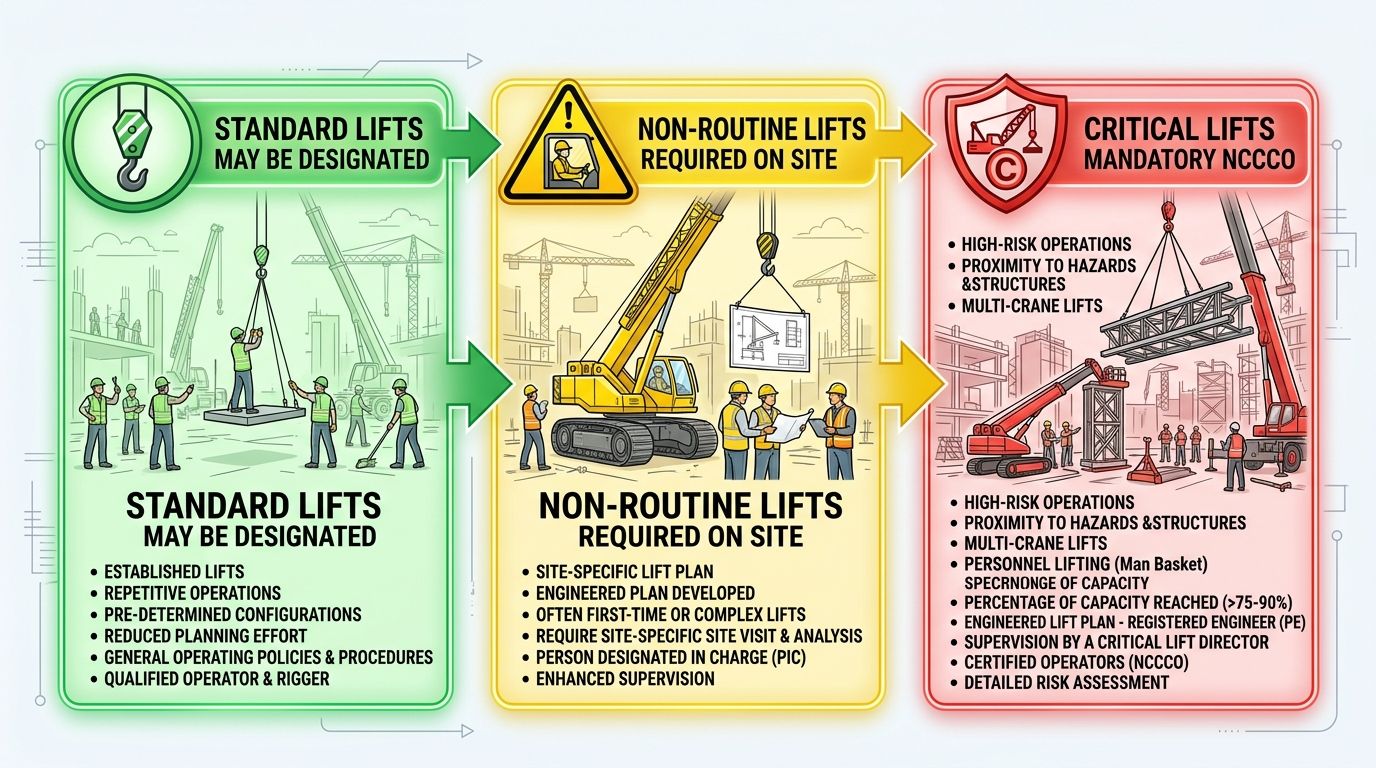
ASME P30.1 lift planning categories infographic for standard, non-routine, and critical lifts.
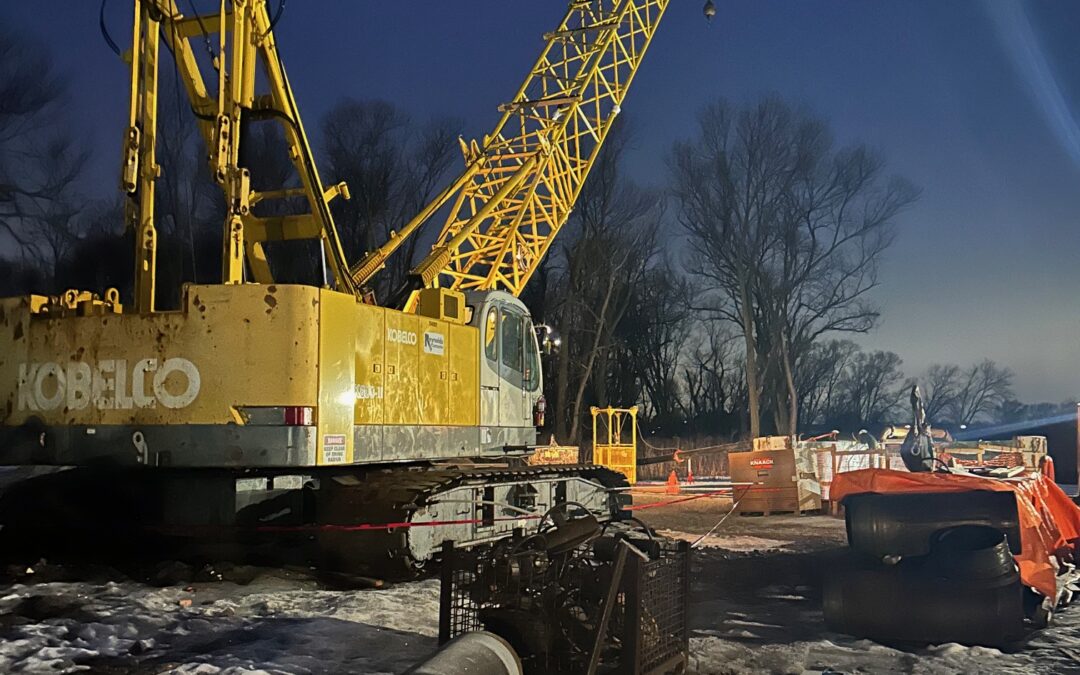
Critical Lifts involve extreme loads, hazardous proximity, or personnel hoisting. ASME P30.1 requires a comprehensive critical lift plan with engineering review, and the lift director must hold NCCCO certification. For example, on a recent critical lift, our NCCCO-certified lift director managed a utility infrastructure lattice boom crane project, coordinating with engineers and field crews to execute the lift safely.
Our certified lift directors ensure compliance across all categories, delivering safety-first execution nationwide. Safety isn’t just a standard — it’s our promise.
Frequently Asked Questions About Lift Directors
What is a lift director?
A lift director is the competent person responsible for planning, supervising, and executing crane lifts. This role ensures all operations comply with OSHA regulations and that every crew member understands their duties. When you engage our NCCCO-certified lift directors, you gain a professional who coordinates the lift from initial site assessment through final placement, prioritizing safety and efficiency.
What certifications does a lift director need?
The primary credential for a lift director is NCCCO Lift Director certification, validating comprehensive knowledge of safe lifting practices. A qualified lift director also holds rigging and signalperson certifications and possesses a thorough understanding of lift planning per ASME P30.1. This combination of credentials ensures they can develop a detailed critical lift plan and manage complex operations.
What is the lift director’s role in a critical lift?
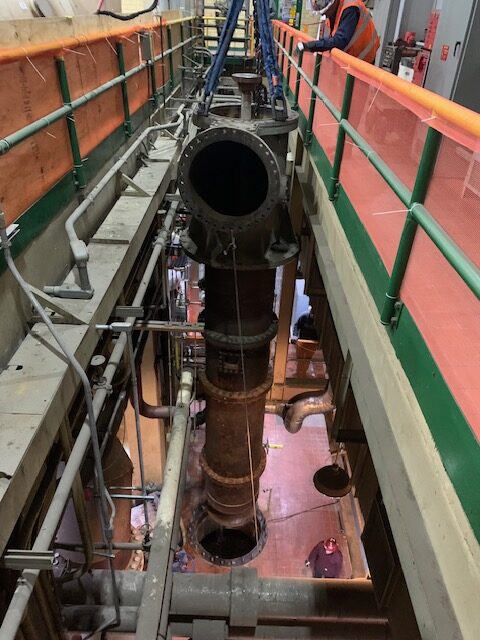
For high-risk operations, the lift director develops the critical lift plan and conducts pre-lift meetings to verify weight calculations, crane setup, and ground conditions. Our team demonstrated this by managing the lift director duties for a municipal well system crane project. We deliver safe, professional, and reliable crane and rigging solutions that support your project’s success.
Elevate Your Project with Professional Lift Direction
Every critical or complex lift demands a professional lift director to safeguard personnel and property. Under OSHA’s 29 CFR 1926 Subpart CC and ASME P30.1, a lift director’s primary duty is planning, walking down, and supervising each lift. Our NCCCO-certified, nationwide lift directors bring deep industry expertise to construction, oil and gas, power generation, and industrial projects. Through critical lift planning and real-time oversight, we deliver safe, professional, and reliable crane and rigging solutions. Safety isn’t just a standard, it’s our promise, reducing incidents, downtime, and compliance burdens. With professional lift direction, you gain a partner who keeps your project moving forward. We Are Ready to Elevate Your Project!.