Table of Contents
The Role of a Crane Consultant in Modern Construction
In today’s fast-paced construction landscape, a crane consultant has become an indispensable partner for navigating complex lifting operations. We see a growing reliance on these specialized professionals to bridge the gap between ambitious project demands and the uncompromising need for safe, compliant execution on every job site.
A crane consultant’s core responsibilities extend into detailed critical lift planning, where we engineer every step of a high-risk hoist, and thorough OSHA crane compliance audit practices, ensuring strict adherence to the safety standards set by the Occupational Safety and Health Administration (OSHA). Our work integrates this expertise with comprehensive industrial crane and rigging solutions to address a project’s full scope. We perform meticulous job walkdowns and serve as certified lift directors, orchestrating seamless coordination between riggers, operators, and project managers to maintain control from initial assessment through final placement.
This proactive oversight delivers value that goes far beyond regulatory checklists. By embedding a consultant into the workflow, teams unlock improved site efficiency and significantly reduced risk. We bring NCCCO-certified expertise that translates complex logistics into safe, professional, and reliable outcomes, because safety isn’t just a standard — it’s our promise. This expertise becomes especially critical when planning complex lifts, which we explore next.
Core Services Provided by a Crane Consultant
As a full-service crane consultant, we combine field-proven experience with NCCCO-certified expertise to help contractors and facility owners manage complex lifting operations safely and efficiently. Our nationwide team mobilizes quickly to any site, ensuring every lift aligns with OSHA regulations and ASME standards. The table below summarizes the four essential services that keep your projects compliant, on schedule, and risk-free.
| Service Offering | Crane Consultant Role | Client Benefit |
|---|---|---|
| Compliance Audits | Conducts thorough reviews of equipment, documentation, and procedures against OSHA/ASME standards | Reduces citation risk and ensures regulatory compliance |
| Critical Lift Planning | Develops detailed written lift plans including load calculations, crane selection, and lift sequence | Enhances safety, improves load stability, and keeps the project on schedule |
| Equipment Selection | Advises on optimal crane type, capacity, and configuration based on job site constraints and lift requirements | Optimizes cost efficiency and performance while reducing downtime |
| On-Site Oversight | Supervises lift operations, verifies that procedures are followed, and provides real-time guidance | Ensures consistent adherence to safety plans and immediate response to issues |
Compliance Audits. We conduct systematic reviews of your equipment condition, maintenance records, and lift procedures against the current OSHA 29 CFR 1926 Subpart CC requirements and ASME B30 standards. This proactive approach uncovers gaps before an inspector arrives, directly reducing your risk of citations and work stoppages. When clients ask for an OSHA crane compliance audit, our NCCCO-certified consultants deliver thorough reports that document every finding and recommend corrective actions so you can demonstrate compliance with confidence.
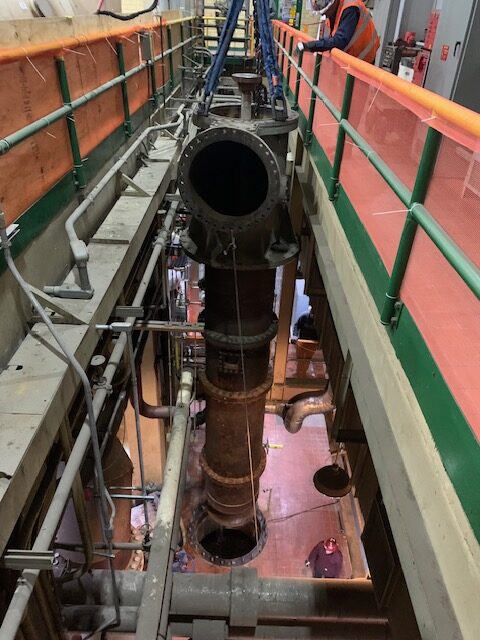
Critical Lift Planning. Every high-risk lift demands a written plan that accounts for load dynamics, site geometry, and personnel placement. We develop detailed lift plans that specify the crane model, rigging configuration, load calculations, and step-by-step sequencing. For a complex power plant pump replacement lift planning project, we coordinated engineering reviews, verified clearances, and integrated contingency procedures–ensuring the operation stayed within safety margins and avoided costly delays. This meticulous focus on critical lift planning turns a potentially hazardous operation into a controlled, predictable event.
Equipment Selection. Choosing the wrong crane or configuration can lead to productivity losses and safety issues. Our consultants evaluate your job-site constraints–ground conditions, overhead obstructions, radius requirements–and recommend the optimal crane type, capacity, and setup. The result is a cost-efficient lift that maximizes equipment utilization and minimizes downtime, all while meeting the load-handling demands of the project.
On-Site Oversight. When a lift unfolds, having an experienced consultant on the ground makes a decisive difference. We supervise the entire operation, verifying that the approved lift plan is followed, that all personnel adhere to their roles, and that any unexpected condition is addressed in real time. This hands-on presence reinforces safety discipline and delivers the immediate response needed to keep the project moving forward.
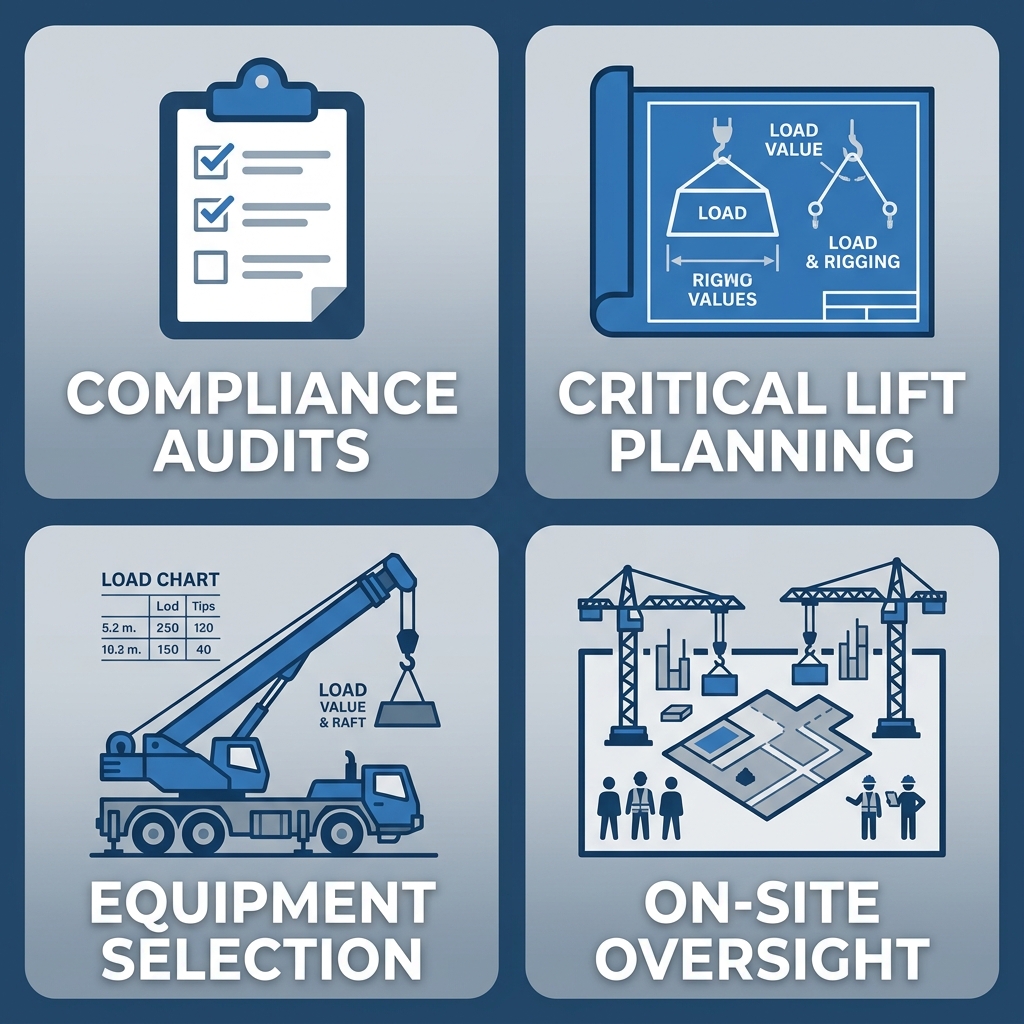
Core crane consultant services overview infographic
These four services form the backbone of our consulting approach. By integrating compliance audits, critical lift planning, equipment selection, and on-site oversight, we deliver safe, professional, and reliable crane and rigging solutions that support your project’s success–start to finish. With NCCCO-certified personnel and nationwide availability, we’re ready to elevate your project the moment you call.
Navigating Critical Lift Planning and Regulatory Standards
For a crane consultant, critical lift planning is the foundation of safe and compliant lift operations. Navigating the differences between OSHA and ASME standards is essential, as each framework imposes distinct triggers and documentation rules. At Crane Industry Experts, we combine regulatory insight with hands-on expertise to develop lift plans that meet all applicable requirements.
The following table highlights the key differences between OSHA and ASME critical lift requirements, helping teams choose the right compliance path.
| Aspect | OSHA (29 CFR 1926.1400) | ASME B30 Series |
|---|---|---|
| Trigger Weight Threshold | 75% of rated capacity (or as defined by manufacturer) | Varies by equipment; typically >75% of rated capacity |
| Annual Inspection Requirement | Required under 29 CFR 1926.1412 (monthly/quarterly/annual) | Required per manufacturer and ASME B30.5 (annual or more frequent) |
| Lift Director Certification | Must be competent person with knowledge of load | Recommended certification (e.g., NCCCO Lift Director) |
| Written Plan Format | Must include load weight, crane setup, lift sequence, and safety measures | Detailed plan including rigging, equipment, and environmental factors |
Understanding these differences is the first step toward building a plan that satisfies applicable regulations.
To choose the right framework, it’s essential to understand the key differences in more detail.
Key Differences Between OSHA and ASME Critical Lift Standards
In critical lift planning, OSHA and ASME standards define operations differently. OSHA’s 29 CFR 1926.1400 triggers a critical lift at 75% of rated capacity, or as the manufacturer specifies. The ASME B30 series varies the threshold by equipment type; for example, mobile cranes (B30.5) and tower cranes (B30.3) may have different criteria. This means that a lift critical under OSHA might not automatically be critical under ASME unless equipment-specific conditions are met.
Inspection requirements also differ. OSHA requires monthly, quarterly, and annual equipment inspections under 1926.1412, while ASME mandates at least annual checks per the manufacturer and B30.5, often recommending more frequent inspections. For lift directors, OSHA only requires a competent person with load knowledge, whereas ASME recommends–but does not require–a certified lift director, such as one holding an NCCCO Lift Director credential. Written plans: OSHA demands load weight, crane setup, lift sequence, and safety measures; ASME extends this to include detailed rigging data and environmental factors like wind speed. Both frameworks aim to prevent accidents, but their documentation and qualification requirements differ significantly. Knowing these distinctions helps align your critical lift planning with the applicable standard, ensuring both safety and compliance.
With these differences in mind, here are the components your plan must include to meet OSHA’s 2026 standards.
Essential Components of an OSHA-Compliant Critical Lift Plan for 2026
A compliant plan begins with precise load calculations–weight, dimensions, and center of gravity. Crane positioning must account for site obstacles and ground stability, verified against the crane’s load chart. A step-by-step lift sequence details rigging attachment, sling angles, and hoisting steps. Communication protocols include radio channels and a designated signalperson. Contingency procedures for power loss or sudden weather changes are mandatory.
For multiple crane lifts, OSHA 1926.1432 requires a separate plan with load distribution analysis and a single lift director overseeing all cranes. Pre-lift meetings with the crew are required to review the entire plan. Regular OSHA crane compliance audits confirm that documentation and inspection records remain current. At Crane Industry Experts, our NCCCO-certified lift directors develop these detailed plans, ensuring every element meets federal standards. Incorporating these components builds a robust foundation for safe lifting operations, reducing the risk of regulatory violations and on-site incidents.
Ultimately, effective lift planning translates directly into safer job sites.
How Critical Lift Planning Improves Safety in High-Risk Environments
Effective critical lift planning directly enhances safety by addressing specific hazards. For example, wind-speed limits of 20 mph for tower cranes, paired with anemometer monitoring, prevent tip-overs. Load instability from improper sling angles or off-center picks is mitigated through calculated center-of-gravity checks. For projects such as municipal well construction crane services, an OSHA-compliant plan minimizes these risks in challenging environments. Safety isn’t just a standard–it’s our promise. With our NCCCO-certified lift directors overseeing operations, we deliver safe, professional lift execution from start to finish.
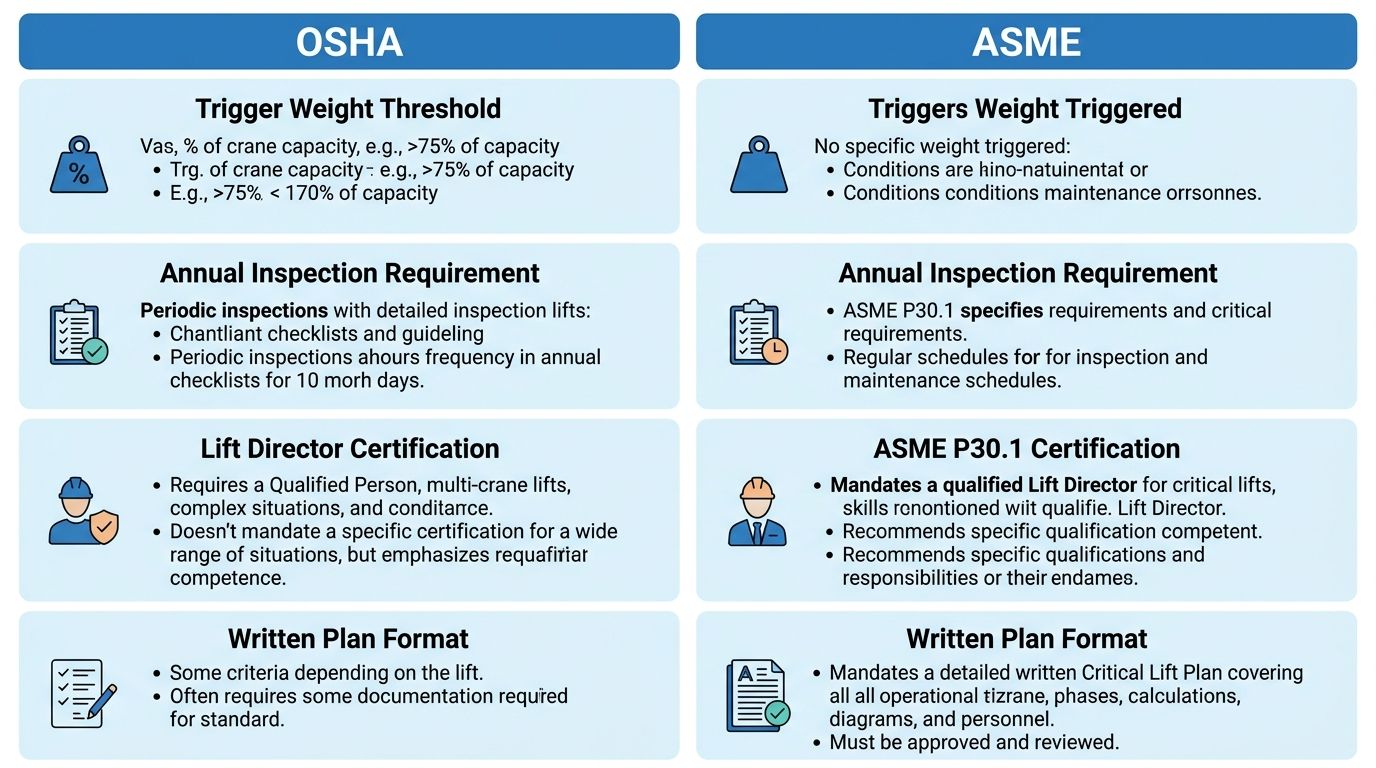
Quick reference for critical lift planning standards.
Preparing for OSHA Crane Compliance Audits
Understanding the regulatory framework is the foundation; now let’s explore how to prepare for the audit itself. Working with a crane consultant can streamline audit preparation by identifying documentation gaps and ensuring your site meets OSHA standards before an inspector arrives. An OSHA crane compliance audit demands meticulous attention to recordkeeping, equipment condition, and operator qualifications.
Common Citations Found During Crane Compliance Audits
Crane safety audits routinely uncover patterns that can be avoided with proactive preparation. The most frequent violations cited under 29 CFR 1926.1412 include:
- Failure to perform daily or monthly inspections per §1926.1412 – many sites lack recent, signed records or cannot demonstrate a consistent inspection rhythm.
- Missing or outdated operator certification and training records – auditor will verify that every operator holds current NCCCO certification and that training documentation is easily accessible.
- Defective or missing safety devices – load moment indicators, anti-two-block devices, and other safeguards must be operational and documented. Inadequate critical lift planning–missing lift plans for complex picks–is a related citation that compromises overall site safety.
- Inadequate recordkeeping for wire rope inspections and replacement – OSHA requires thorough logs that track wire rope condition and replacement dates.
- Incomplete accident logs and corrective action records – gaps in incident documentation can escalate an audit into a wider investigation.
These citations underscore why a systematic, documented approach to crane maintenance and operator management is essential. According to OSHA’s standard, all inspections must be performed by a qualified person and records retained for the required period. A well-executed compliance audit preparation process eliminates these vulnerabilities before a regulator steps on site.
Step-by-Step Guide to Passing a 29 CFR 1926.1412 Audit
A successful OSHA crane compliance audit hinges on having the right documentation ready and the team aligned on responsibilities. Review real-world examples, such as our utility infrastructure crane project in Cedar Rapids, to see how audit preparation translates to field success. Follow these steps to build a robust compliance file:
- Compile all daily inspection reports for the past 12 months, ensuring each entry includes the date, inspector’s name, and specific observations.
- Verify that every crane’s monthly inspection documentation is signed by a qualified person and that the reports are retained for at least the duration of the crane’s service plus 12 months, per OSHA guidelines.
- Review operator certifications against NCCCO standards, confirming that credentials are current and that training records are organized and accessible.
- Conduct a pre-audit walk-down to check all safety devices–load indicators, anti-two-block systems, horns, and limit switches–and document their condition.
- Prepare a corrective action log that clearly shows how any past deficiencies were identified, resolved, and verified. Include dates and the names of responsible parties.
- Schedule a third-party internal audit approximately 30 days before an official OSHA audit to uncover any remaining gaps and demonstrate a proactive safety culture.
- Ensure that all lift plans for critical picks are documented, reviewed, and signed by a qualified lift director.
When these steps are fully executed, your team can walk into an OSHA inspection with confidence.
Third-Party Audits vs. Internal Inspections: What’s the Difference?
Monthly equipment inspections and full safety compliance audits serve distinct purposes under OSHA’s framework. A monthly inspection is a focused, equipment-centric review conducted by a qualified person–often a company employee or hired inspector–who examines brakes, controls, wire rope, hooks, and safety devices. In contrast, a comprehensive audit evaluates the entire operation: all equipment, documentation, operator qualifications, lift planning, and procedural adherence. The table below clarifies key differences between these essential practices.
| Feature | Monthly Equipment Inspection | Full Safety Compliance Audit |
|---|---|---|
| Scope | Focus on crane components: brakes, controls, wire rope, hooks, safety devices | Comprehensive review of all equipment, documentation, operator qualifications, and procedures |
| Required Documentation | Daily and monthly inspection reports | All inspection records, training certificates, accident logs, maintenance history |
| Frequency | Monthly (per 29 CFR 1926.1412) | At least annually or when triggered by incidents/regulatory changes |
| Conducted By | Qualified person (often company employee or hired inspector) | Third-party certified safety consultant or audit firm |
| Outcome | Identifies immediate maintenance needs | Provides overall compliance status and risk mitigation recommendations |
The monthly inspection is an ongoing operational check, while the full audit is a strategic evaluation that ensures your entire lifting program meets OSHA and ASME B30.5 standards. Both are essential: the monthly process keeps equipment safe on a daily basis, and the annual audit validates that your documentation, training, and procedures are audit-ready. With a thorough audit preparation plan, you can confidently address any gaps–and our NCCCO-certified team is ready to assist. We Are Ready to Elevate Your Project!
Advanced Lift Planning and On-Site Oversight Strategies
While basic lift plans cover routine hoists, complex projects demand advanced lift planning for engineered lifts, critical lifts, and multi-crane operations. As a crane consultant, Crane Industry Experts provides the technical guidance and on-site oversight needed to navigate these high-stakes scenarios safely and in full compliance with federal regulations.
Advanced lift planning goes beyond standard load charts and rigging checks. It involves detailed engineering calculations, site-specific hazard assessments, and coordination of multiple cranes when necessary. OSHA’s 1926.1432 standard for multiple-crane lifts mandates a written plan developed by a qualified person long before lifting begins. In critical lift planning, we integrate crane selection, ground bearing capacity, and wind-load analysis to preemptively eliminate risks. Every plan accounts for the unique demands of the project, from congested job sites to lifts over existing structures.
Effective on-site oversight transforms a solid plan into a flawless execution. We deploy NCCCO-certified lift directors who conduct pre-lift meetings, verify load calculations in real time, and monitor every phase of the operation. For sensitive environments like healthcare facilities, our NCCCO-certified hospital expansion crane lift director coordinates with facility managers to maintain uninterrupted operations while ensuring strict adherence to safety protocols. Continuous job walkdowns and tool-box safety talks reinforce situational awareness among all crew members, preventing miscommunication and procedural drift.
Regulatory compliance underpins every advanced lift we undertake. Our personnel maintain current NCCCO certifications, and we align all lift plans with OSHA’s Subpart CC requirements, including operator qualification and signaling standards. Through an OSHA crane compliance audit of the site and documentation, we identify gaps before they become citations. This proactive approach not only safeguards workers but also protects project schedules. By embedding compliance into daily oversight, we deliver lifts that meet both federal rules and client expectations for safety and efficiency.
With expert consultation, even the most complex crane operations become managed processes where risk is minimized and success is measured by on-time, incident-free placements.
Frequently Asked Questions About Crane Consulting Services
Now, let’s answer some common questions about how our crane consulting services work in practice.
- What does a crane consultant do? We provide NCCCO-certified personnel who conduct lift planning, safety audits, and on-site oversight for complex, high-risk lifts.
- What does presidential library crane consultation include? Our team provides custom lift studies, logistical coordination for historic and sensitive sites, and rapid mobilization for presidential library crane consultation projects.
- How does crane consulting support OSHA compliance? Our crane consulting expertise includes OSHA crane compliance audits and lift plans that meet OSHA/ASME standards, reducing risk and ensuring regulatory compliance.
- Do you offer nationwide crane consulting? Yes, we provide nationwide critical lift planning and deploy teams anywhere in the U.S. from our Indiana base on short notice.
Ready to discuss your project? Contact our team today.
Leveraging Crane Consulting for Project Success
Partnering with a crane consultant is a strategic move that directly impacts project success. Our NCCCO-certified personnel and lift directors provide nationwide, rapid-response support, ensuring safe lift planning and onsite oversight for projects across the U.S. With a crane consultant’s expertise in critical lift planning and OSHA crane compliance audits, our lifting specialists, rigging advisors, and compliance experts reduce risk and keep you compliant with OSHA and ASME standards. We deliver safe, professional, and reliable crane and rigging solutions that support your project’s success — start to finish.