Table of Contents
Crane Safety Consultants: Your Partner in OSHA Compliance and Risk Reduction
As your dedicated crane safety consultants, we help you navigate complex OSHA standards while reducing risk on every lift. We understand that compliance isn’t just about avoiding fines — it’s about protecting your people and your project’s bottom line. Our role is to bridge the gap between regulatory complexity and operational efficiency, ensuring your team can focus on execution with confidence.
Achieving full compliance requires a thorough understanding of OSHA’s 29 CFR 1926 Subpart CC, which mandates operator certification, regular inspections, and proper ground conditions. We conduct thorough OSHA crane compliance audits to verify that every aspect of your operation meets federal safety standards. Our team brings nccco certification crane operations experts who verify that every lift meets regulatory standards, from the operator in the cab to the signalperson on the ground. Safety isn’t just a standard — it’s our promise, and we embed this philosophy into every compliance check we perform.
Proactive risk reduction is where we deliver immediate value. Through critical lift planning, we identify hazards before they become incidents, analyzing load dynamics, site constraints, and environmental factors. Our on-site oversight and safety audits catch overlooked risks — from ground stability issues to inadequate rigging — allowing us to correct them before work begins. This preventative approach directly reduces downtime and potential liabilities, keeping your project on schedule and within its risk tolerance.
With nationwide availability and rapid mobilization, our team is ready to support your next lift, wherever your project takes you.
Core Services and Certifications Offered by Crane Safety Consultants
To deliver safe and reliable operations, our team of crane safety consultants provides a comprehensive range of specialized services backed by rigorous certification standards. As a leading crane industry experts company, we deploy NCCCO-certified personnel who bring critical lift planning expertise and OSHA crane compliance audits to every project across the United States. Our professionals are trained to the highest industry standards, from operators executing precise lifts to lift directors coordinating complex, high-risk activities. This combination of certified roles ensures that every lift proceeds with technical precision and full regulatory compliance.
The following table provides a quick overview of the core roles, their primary responsibilities, the certifications they hold, and how they typically contribute during on-site operations:
| Role | Primary Responsibilities | Certification Requirement | Typical On-Site Role |
|---|---|---|---|
| Crane Operator | Operate mobile or tower crane; execute lifts per plan | NCCCO certification required | Daily operations |
| Rigger Level I/II | Attach and secure loads; inspect rigging gear | NCCCO rigger certification (Level II for complex loads) | Lift preparation |
| Signalperson | Communicate lift instructions to operator | NCCCO signalperson certification | During lifts |
| Lift Director | Oversee all crane activities; approve lift plans | NCCCO lift director or equivalent | High-risk / critical lifts |
These certified professionals form the backbone of every lift, ensuring compliance and safety from planning to execution. We deploy crane operators to manage daily mobile and tower crane activities, executing each movement precisely according to the engineered lift plan. Our riggers, certified at Levels I and II, are responsible for preparing loads and inspecting all rigging gear, with Level II specialists specifically handling the most complex and non-standard lifts. Signalpersons certified by NCCCO provide clear, standardized communication with operators, a role mandated by OSHA regulations to prevent accidents that can arise from miscommunication.
For projects involving high-risk or technically demanding lifts, our certified lift directors take charge of the entire process. They develop critical lift plans, approve all procedures, and oversee on-site execution to ensure absolute safety. This rigorous approach to assembling a fully certified team means that every phase of your project benefits from specialized expertise. Whether you need a single operator for a week-long job or a full complement of rigging and lifting specialists for a major construction initiative, we prioritize rapid national mobilization. Our team arrives on-site ready to work, bringing the certifications, skills, and safety mindset that modern crane operations demand. Safety is not just a standard; it is our promise on every project.
Critical Lift Planning and OSHA Compliance Audits Explored
Understanding the regulatory framework that governs high-risk hoisting operations is essential for every project team. We rely on established standards and the expertise of crane safety consultants to ensure every lift meets federal and industry requirements.
Understanding OSHA Requirements for Critical Lift Plans
A critical lift plan is not an optional document. It is a mandatory requirement under OSHA 29 CFR 1926.1400 whenever a lift exceeds 75% of a crane’s rated capacity, as defined by ASME B30.5. The Occupational Safety and Health Administration (OSHA) also requires a critical lift plan for any operation involving tandem lifts, the use of personnel baskets, or work conducted in hazardous environments. These triggers move a routine procedure into a high-stakes category that demands rigorous pre-planning.
We apply these standards during every job walkdown. The goal is simple: identify the hazard, quantify the risk, and build a plan that controls it. Without a formal plan, site leadership assumes liability for what could be a preventable incident. In our experience, integrating critical lift planning early in the project schedule avoids costly delays and last-minute engineering changes.
Engineering Data Required in a Critical Lift Template
A complete critical lift plan must contain more than just the basic load weight. It requires detailed load calculations that factor in the lift weight, the crane’s rated capacity at the working radius, and the specific boom length and angle. Ground bearing pressure analysis is equally important, comparing the crane’s outrigger loads against the soil bearing capacity data provided by the project’s geotechnical report. Our Lift Directors confirm these numbers on site because inconsistent soil conditions can derail even the most carefully calculated plan.
The template also includes full crane configuration data, such as the crane type, outrigger layout, and all rigging details. This means recording every sling angle, shackle rating, and hook configuration. When we assemble these documents, certified rigging services crane industry standards recommend recording hook configuration and sling angles to ensure redundancy in the load path.
| Aspect | Ordinary Lift Plan | Critical Lift Plan |
|---|---|---|
| Definition | Routine lifts within standard parameters | Lifts exceeding 75% of crane capacity (per ASME B30.5) or involving special hazards |
| Triggers | Normal operating conditions | Capacity >75%, tandem lifts, personnel baskets, hazardous environments |
| Documentation | Basic lift plan with load weight and radius | Detailed plan including ground bearing pressure, engineering calculations, contingency procedures |
| Approval | Operator / Supervisor approval | Requires Lift Director and site safety manager approval |
| Frequency | Performed regularly without special oversight | Requires pre-lift meeting and on-site supervision |
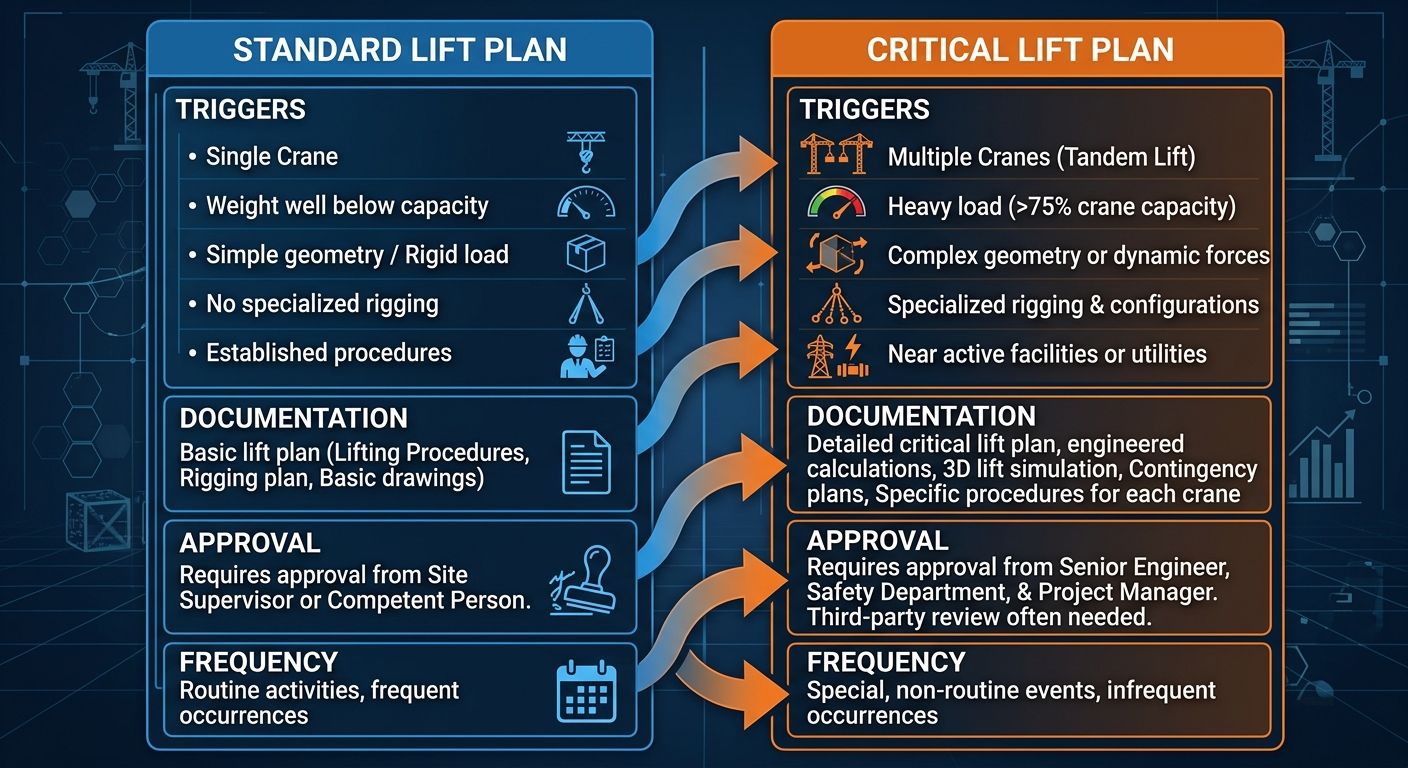
Comparison of ordinary and critical lift plan requirements.
Preparing Documentation for OSHA 29 CFR 1926.1412 Inspections
OSHA 29 CFR 1926.1412 mandates that employers maintain two distinct categories of crane inspection records. Frequent inspections, conducted daily to monthly, must be documented to show that the crane was checked for visible damage, control function, and wire rope integrity. Periodic inspections are a more comprehensive annual review, and their records must demonstrate the machine was disassembled as necessary to examine structural components.
Our OSHA crane compliance audits verify that every required document is present and properly signed by a qualified person. This includes proof of any repairs or modifications performed since the last inspection. According to the Washington State Department of Labor & Industries, state-level rules under WAC 296-155 can impose even stricter recordkeeping requirements, so we treat the OSHA standard as the floor, not the ceiling. Our team systematically reviews logbooks, load test certifications, and non-destructive testing reports to ensure full transparency before a compliance officer ever arrives on site.
Who is Qualified to Conduct Annual Crane Compliance Audits?
Only a qualified person may perform the annual comprehensive inspection required under OSHA 29 CFR 1926.1412. Industry practice, reinforced by NCCCO certification standards, sets a high bar for this role. A third-party auditor must hold accredited credentials, possess at least five years of crane-related experience, and maintain independence from the crane owner or operator to avoid any conflict of interest.
Our crane safety consultants meet these criteria through a combination of NCCCO-certified personnel and ongoing field expertise across diverse project sites. By remaining independent from the fleets we inspect, we provide objective, defensible audit reports that general contractors and facility owners can submit with confidence. Safety is not just a standard — it is our promise. We deliver safe, professional, and reliable crane and rigging solutions that support your project’s success — start to finish.
Preparing Your Job Site for Safety Audits and Risk Reduction
At Crane Industry Experts, safety isn’t just a standard — it’s our promise. Engaging crane safety consultants early in your project helps align every lift with OSHA and ASME standards while reducing on-site risk. Once you understand the critical role these professionals play, the next step is preparing your job site — a process we walk you through below.
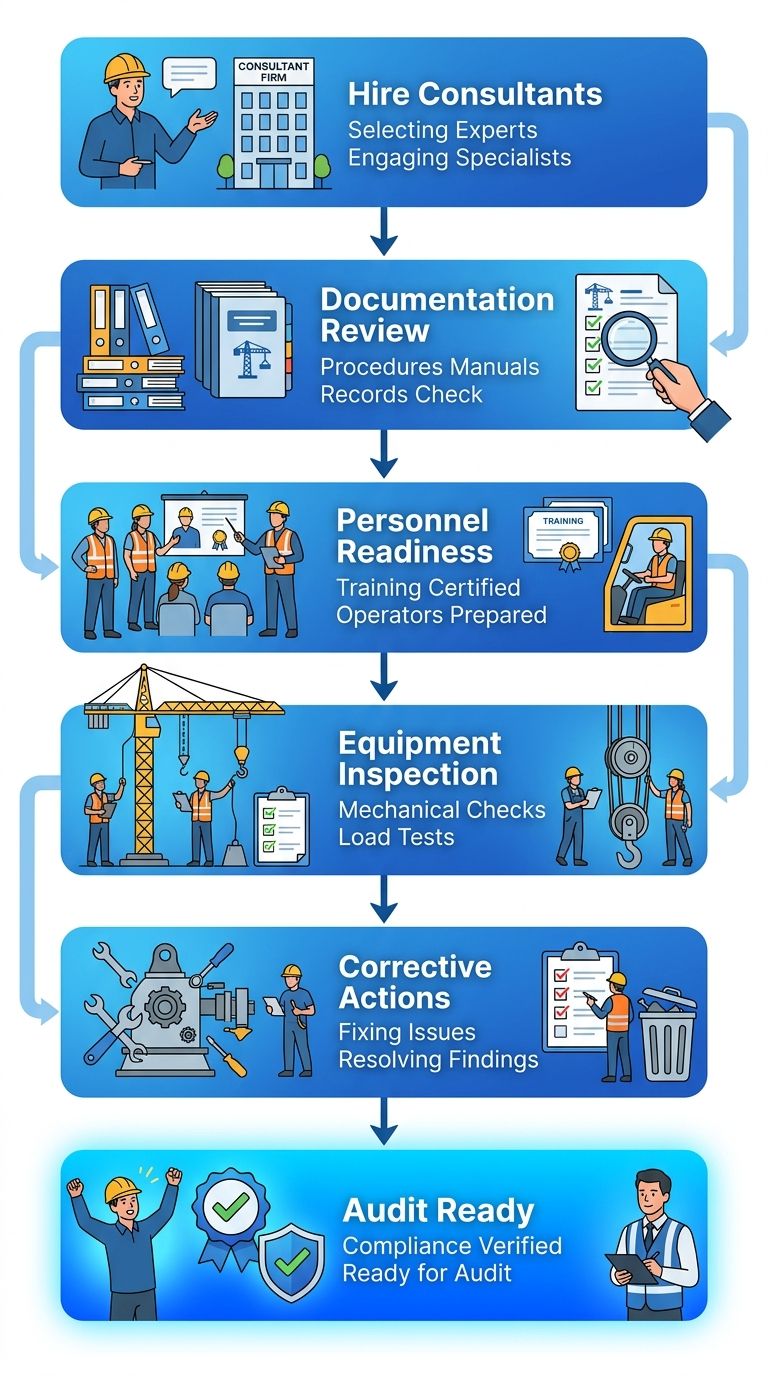
Vertical crane safety audit preparation process flow
When to Hire Crane Safety Consultants for Your Project
We recommend hiring crane safety consultants when specific risk factors indicate a need for specialized oversight. High crane density on a congested site, upcoming multi-crane lifts that demand precise coordination, the launch of a new project phase, a history of OSHA violations, or the introduction of an unfamiliar equipment type all warrant bringing in professional help. Projects with a history of OSHA violations or unfamiliar equipment types also benefit greatly from expert involvement. Our NCCCO-certified personnel and lift directors have experience across many industries served Crane Industry Experts, from construction to power generation. Early engagement with a lift planning consultant allows us to assess site conditions, validate load calculations, and develop engineered lift plans that mitigate risk before the first pick. This proactive approach keeps your project compliant and on schedule.
Steps to Prepare Your Job Site for a Third-Party Safety Audit
Preparing for OSHA crane compliance audits begins with a clear plan. We focus on four essential preparation actions:
- Verify NCCCO certifications for all operators and riggers.
- Organize inspection logs (daily, frequent, periodic).
- Compile lift plans for all critical lifts.
- Perform a documented pre-audit walkdown with corrective action tracking.
Reducing Risk During Critical Lift Operations
Critical lift planning is the cornerstone of risk reduction during complex operations. Our lift directors develop engineered lift plans that include detailed load charts, crane positioning diagrams, and contingency procedures for every possible variable. On-site, we supervise the lift in real time, making adjustments for changing weather conditions or unexpected ground bearing capacity. This continuous oversight allows us to spot potential issues before they escalate — whether a sudden wind gust alters the load radius or the soil compresses under outrigger pressure. By having an NCCCO-certified lift director present, your team gains a partner who can immediately recalibrate the plan while maintaining compliance with OSHA and ASME standards. Pre-lift briefings ensure every crew member understands their role and the contingencies for equipment failure or load shift. The result is a safer lift that stays on schedule and avoids costly rework.
Recordkeeping: Frequent vs. Periodic Crane Inspections
Under OSHA 29 CFR 1926 Subpart CC, frequent inspections — performed monthly or every three months as specified by the manufacturer — must be documented on a checklist or report form. Periodic inspections, which occur annually or every four years for certain equipment, require a detailed written report certified by a qualified person. A common pitfall is failing to have the periodic report signed by that qualified person, which can nullify compliance. We help maintain accurate records that meet federal standards. Proper recordkeeping demonstrates continuous compliance and protects your team.
Mitigating Risk and Avoiding OSHA Penalties Through Proper Compliance
Beyond understanding the rules, taking action to mitigate risk is what keeps projects penalty-free. For companies seeking crane safety consultants, understanding OSHA’s penalty structure is the first step toward protecting both your workforce and your bottom line. The Occupational Safety and Health Administration categorizes violations into four tiers, each carrying steep maximum fines in 2026.
According to the Occupational Safety and Health Administration, maximum fines for crane-related violations can reach $161,323 for willful or repeat offenses. The table below summarizes the four violation types and their 2026 penalties.
| Preparation Activity | Internal Pre-Audit | External Audit Preparation |
|---|---|---|
| Documentation Review | Self-check of training records, inspection logs, lift plans | Compile all records in organized binder for auditor |
| Personnel Readiness | Reinforce safety protocols with crew | Confirm all NCCCO certifications are current and accessible |
| Equipment Inspection | Verify daily/weekly inspection reports are filed | Arrange access to cranes and rigging for physical inspection |
| Corrective Actions | Address minor deficiencies noted in self-audit | Document any unresolved issues with corrective plan |
For crane companies, mitigating Serious violations starts with consistent recordkeeping. Conducting regular osha crane compliance audits — whether performed internally or through third-party experts — ensures that inspection records are accurate and accessible before OSHA arrives. When it comes to Willful penalties, detailed critical lift planning and on-site oversight by certified lift directors prevent catastrophic load-limit breaches. Engaging a professional crane safety consultant for high-risk lifts directly addresses the root causes of repeat violations by embedding expert judgment into every operation.
Ultimately, the surest defense against the steepest OSHA fines lies in the hands of qualified, NCCCO-certified personnel. We deliver certified operators, riggers, and lift directors who bring real-world compliance knowledge to your site, turning regulatory requirements into routine practice. Our NCCCO certified personnel staffing ensures that every professional on your team meets the highest standards. From the first walkdown to the final placement, we embed penalty-avoidance into the DNA of your project. Safety isn’t just a standard — it’s our promise.
Frequently Asked Questions About Crane Safety Consulting
What do crane safety consultants do? We assess worksites, develop lift plans, and ensure OSHA compliance for every project phase. Our NCCCO-certified personnel supervise critical lifts and deliver complete crane rigging and lift planning services that prioritize safety and efficiency.
How does crane safety consulting help with OSHA compliance? We conduct OSHA crane compliance audits to identify gaps and recommend corrective actions based on OSHA 29 CFR 1926 Subpart CC standards. Safety isn’t just a standard: it’s our promise, and we help your operations stay compliant.
What is critical lift planning? Critical lift planning involves pre-engineered lift plans for complex or high-risk lifts. We analyze weights, crane capacity, rigging selection, and site conditions to minimize risk and ensure a safe outcome.
Are your services available nationwide? Yes, our crane safety consultants mobilize from our base in Indianapolis and other service areas to deploy NCCCO-certified personnel across the U.S. for emergency or urgent projects.
Elevate Your Project with Certified Crane Safety Consultants
Expert crane safety consultants bring deep knowledge of federal OSHA and ASME standards to every phase of a lift. By embedding certified oversight into your workflow, teams reduce risk, maintain schedule integrity, and meet the strictest compliance benchmarks — including thorough OSHA crane compliance audits and precise critical lift planning.
As Crane Industry Experts, our NCCCO-certified personnel deliver that assurance across the U.S. with rapid, safety-first lift planning and on-site execution. Safety isn’t just a standard — it’s our promise.