Table of Contents
The Foundation of Every Safe Crane Lift: Effective Lift Planning
At Crane Industry Experts, safety isn’t just a standard — it’s our promise, and that promise starts with crane lift planning. Every safe crane lift begins with meticulous planning — it’s the single most important factor in preventing accidents. OSHA 1926 Subpart CC requires written lift plans for all crane operations, with additional critical lift requirements when lifts exceed 75% of rated capacity or involve multiple cranes. Effective planning determines load weight and center of gravity, verifies crane capacity against the load chart, includes a ground bearing pressure calculation to confirm soil stability, selects proper rigging (slings, shackles, spreader bars), and evaluates the fall zone for personnel safety. Our NCCCO-certified lift directors and personnel execute these steps from job walkdowns through completion. We deliver safe, professional, and reliable industrial crane services backed by rigorous lift planning.
Essential Prerequisites for Crane Lift Planning
Effective crane lift planning requires a solid foundation of prerequisites. Skipping these essential checks is a common root cause of crane accidents, which is why we emphasize thorough preparation. In our experience, four categories must be verified before any lift plan is finalized.
- Site conditions: Ground bearing pressure calculation confirms the soil can support the crane and load; access and egress must accommodate the crane’s travel and setup.
- Load characteristics: Verified weight, center of gravity, and any unusual rigging points ensure proper rigging selection.
- Personnel qualifications: Our NCCCO-certified operators and riggers meet OSHA and ASME standards; all signalpersons are trained per 1926.1419.
- Lift planning documentation: A pre-lift meeting, job safety analysis (JSA), and preliminary lift plan review are required before the lift can proceed.
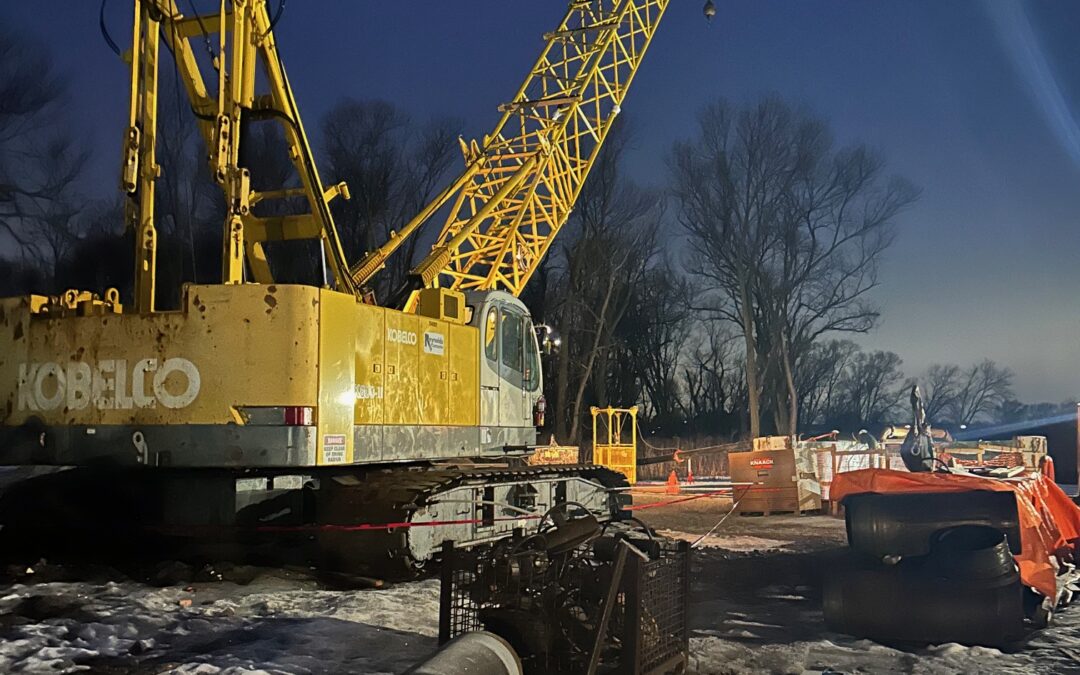
For lifts meeting Critical lift requirements–such as those near energized lines or exceeding 75% of crane capacity–additional engineering review and approvals are required. For example, when positioning a utility infrastructure crane in an urban corridor in Cedar Rapids, ground bearing pressure and swing clearance become critical factors.
Once these prerequisites are confirmed, the lift plan can be developed around the job-specific parameters. The lift director should verify all prerequisites before the plan proceeds to detailed execution, ensuring every lift meets OSHA and ASME safety and compliance standards. This disciplined approach reduces risk and keeps projects on schedule.
Identify Lift Requirements and Site Information
In critical lift planning, the first step is to identify all lift requirements and site information. We begin by gathering every quantifiable factor that could affect the lift, from load characteristics to environmental constraints. Essential lift parameters include load weight, overall dimensions, lift radius, required height, and the load’s center of gravity. These critical lift requirements are documented alongside a thorough site assessment. A detailed lift radius measurement, for instance, directly influences crane capacity and boom angle. Our lift director verifies ground bearing pressure calculation to confirm crane stability, maps out overhead power lines, underground utilities, and access routes, and accounts for weather constraints that could impact the lift. We also evaluate ground conditions, checking for soft soil or voids that could undermine stability. Accurate site and lift data is critical to selecting the proper crane and rigging configuration, and it feeds directly into the lift plan to prioritize safety and compliance.
Select the Right Crane and Configuration
Once lift requirements are documented, the next step is to select the right crane and configuration through careful crane lift planning. For a project such as hospital construction lift planning, selecting the right crane configuration is critical. We evaluate critical lift requirements to ensure the crane’s capacity matches the load weight and lift radius.
- Verify load weight and lift radius as primary capacity determinants.
- Perform a ground bearing pressure calculation to assess soil or floor support.
- Choose the mobile crane type (crawler, truck, all-terrain) or tower crane based on site access, height, and load path.
- Configure boom length, jib attachment, and counterweight for stability and capacity.
- Involve our NCCCO-certified lift directors early to ensure compliance with OSHA and ASME.
With the crane selected, our lift planners deliver safe, professional, and reliable crane and rigging solutions that support your project’s success — start to finish. Attention then turns to site preparation and ground condition verification.
Calculate Load Weight, Center of Gravity, and Rigging
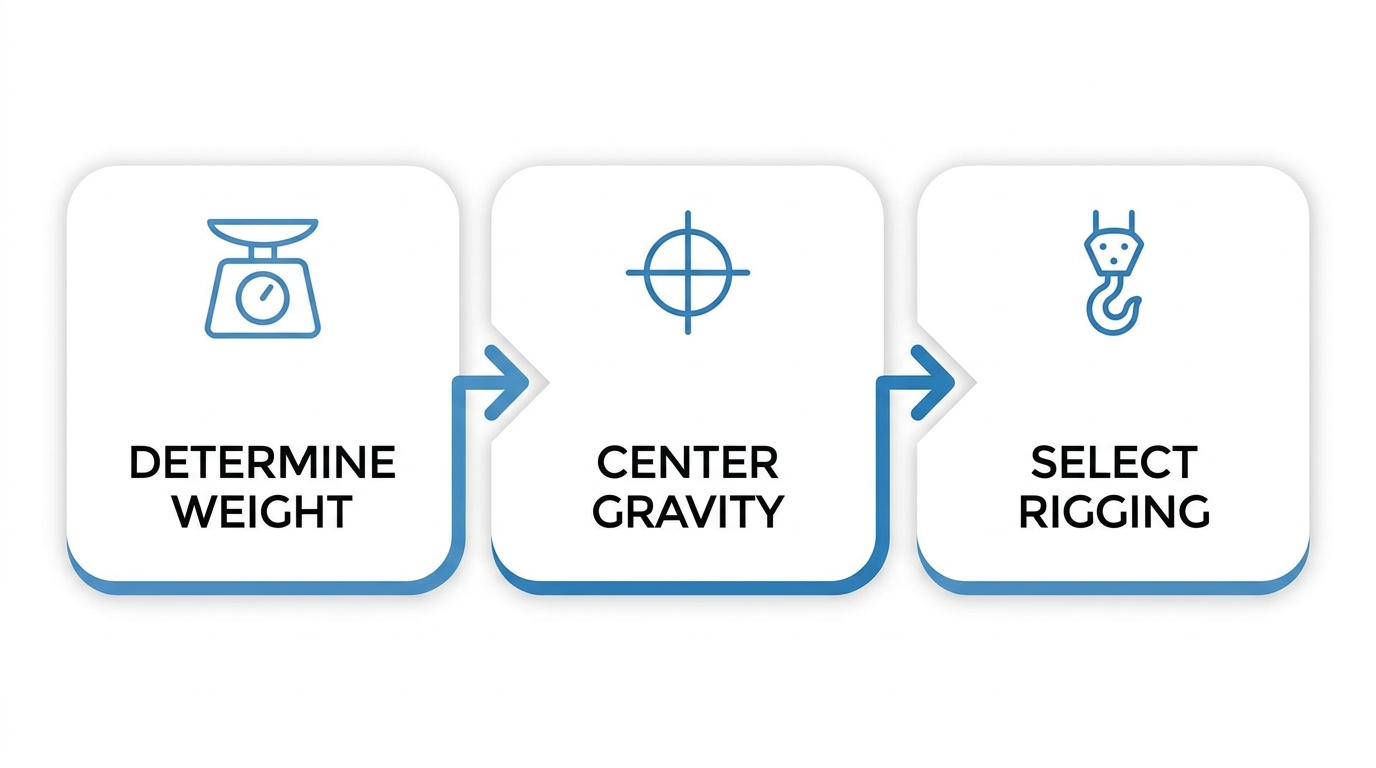
In crane lift planning, the next step is to determine load weight, center of gravity, and rigging. These calculations ensure stability and trigger critical lift requirements when uncertainties arise.
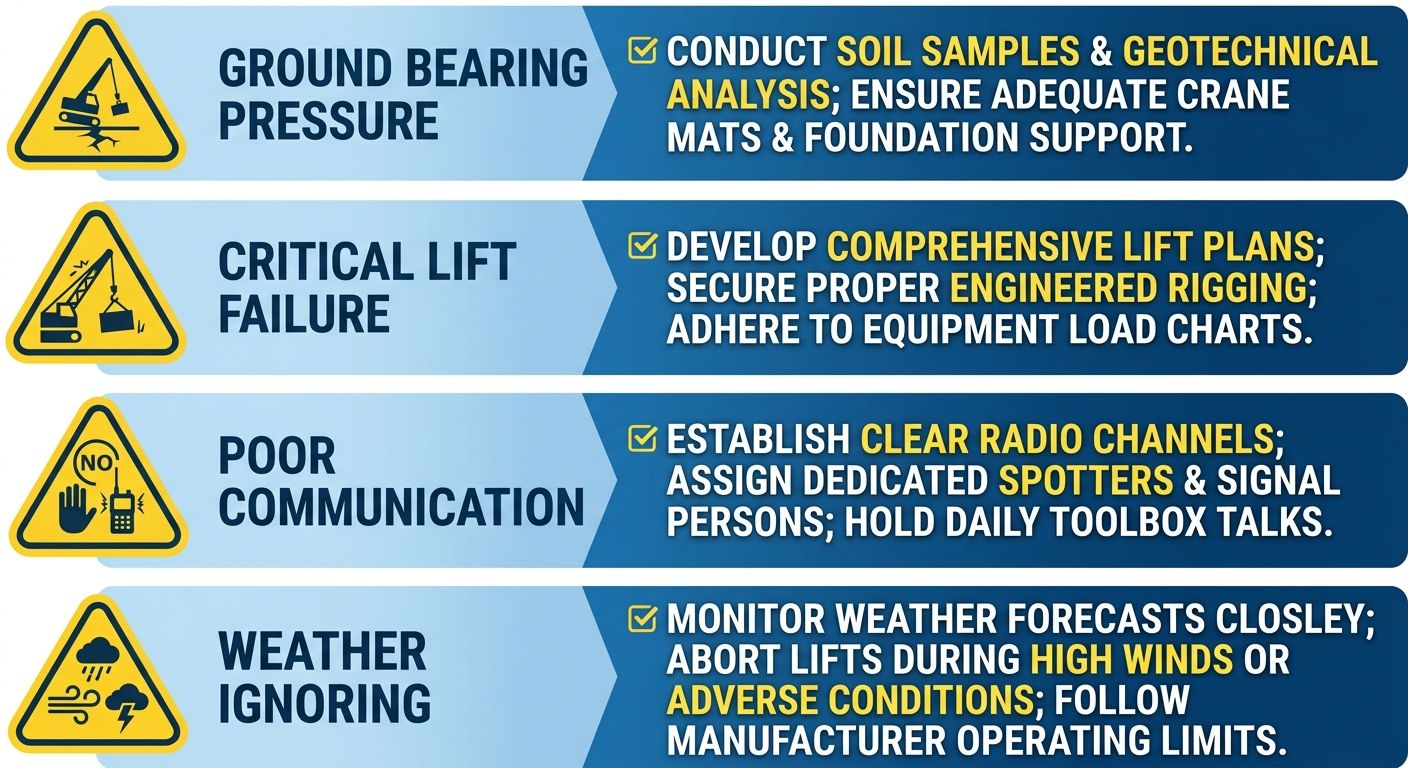
Crane lift planning mistakes and solutions infographic
Three-step load calculation process for crane lift planning.
We determine total load weight by summing the object’s weight (volume × material density) and rigging hardware. We recommend verifying load weight with a certified scale whenever possible. For irregular loads, we locate the center of gravity through geometric decomposition or known data points to prevent tipping. Rigging configuration — sling angles, number of legs, and attachment points — governs load distribution. We calculate sling tension as T = W / (N × sin θ). Incorrect sling angles can surge tension; inaccurate CG risks instability. Lifts where weight or CG remain uncertain automatically meet critical lift requirements, demanding a higher safety classification.
With load and rigging parameters set, we calculate ground bearing pressure to ensure the crane’s outrigger loads are safely distributed. Our NCCCO-certified personnel execute these calculations to deliver safe, reliable solutions — safety is our promise.
Assess Ground Bearing Pressure and Site Stability
Once the lift parameters are defined, the next critical step in crane lift planning is to assess ground bearing pressure and site stability. Ground bearing pressure is the load per unit area that soil can support without failure. Crane outriggers transfer immense loads, so a ground bearing pressure calculation ensures the soil’s capacity is not exceeded.
Geotechnical reports or on-site soil tests provide allowable bearing capacity data. Soil type, moisture content, and compaction all affect stability. Proper outrigger pad sizing using crane mats or cribbing distributes loads to meet capacity. For critical lift requirements, our lift planning service applies heightened scrutiny, similar to the approach used for a municipal well construction crane lift in Sioux Falls, an area we frequently serve.
Safety isn’t just a standard — it’s our promise. Our on-site oversight verifies ground conditions before any lift proceeds. With site stability confirmed, we can proceed to rigging and crane positioning.
Document Lift Parameters in a Compliant Written Plan
Whether we work in Indianapolis or at a remote site, our crane lift planning begins with a written plan that captures every critical lift requirement. We document the exact parameters that OSHA 29 CFR 1926 Subpart CC mandates, starting with these:
- Load weight (including rigging) and crane capacity at the planned radius, confirmed by load moment indicator data.
- Ground bearing pressure calculation to verify that the ground or deck can support the crane and the suspended load under all conditions.
- Lift radius and boom length limits that maintain clearances and stay within the crane’s chart.
- Wind speed limits and weather criteria based on OSHA guidelines, set as go/no-go thresholds to pause the lift if conditions worsen.
- Rigging configuration details–sling angles, attachment points, and hardware ratings.
- Communication methods (hand signals, radios) and the designated signalperson and lift director.
A qualified person reviews every documented parameter against site conditions before any load is lifted, as OSHA requires. This approach turns a routine lift into an engineered, compliant operation that protects people and property.
Review Critical Lift Criteria and Plan Escalation
Once the lift plan is established in crane lift planning, it must be evaluated against critical lift criteria. Our NCCCO-certified personnel check these critical lift requirements:
- Load weight and radius exceeding 75% of the crane’s rated capacity
- Hoisting personnel or lifting over live facilities
- Challenging ground bearing pressure calculation and soil stability
- Proximity to power lines, structures, or other obstacles
When any criterion is triggered, the lift director performs an initial assessment and escalates by notifying the project manager and safety officer. We deliver safe, professional, and reliable lift planning, developing a written critical lift plan that documents load calculations, crane capacity, and ground conditions. OSHA requires this written plan for any critical lift to ensure safety compliance. For a real-world example of an escalated critical lift, review our tandem lift case study. After review and escalation approval, the team can proceed with the lift execution.
Conduct Pre-Lift Meeting and On-Site Verification
After finalizing the lift plan, as part of comprehensive crane lift planning, our Certified Lift Director leads a pre-lift meeting with the entire lift team–operator, riggers, and signalpersons. We review the lift plan, confirm roles and responsibilities, identify hazards such as power lines and wind, and discuss emergency procedures. These NCCCO-certified personnel ensure every team member understands the plan and safety protocols before work begins, creating a shared commitment to a hazard-free operation.
Conducted by our NCCCO-certified team, the on-site verification includes a thorough inspection of the crane and rigging equipment, confirmation of the load weight, and a detailed ground bearing pressure calculation to verify stable support. All activities are performed in compliance with critical lift requirements, and we document meeting minutes and verification checklists to meet OSHA and ASME standards. After these checks, the lift proceeds with full confidence in a safe, compliant execution.
Troubleshooting: Common Crane Lift Planning Mistakes and How to Avoid Them
Even the most experienced teams encounter pitfalls during crane lift planning. Understanding the most frequent errors — and how our experts help you avoid them — keeps your project safe, compliant, and on schedule.
Three-step load calculation process for crane lift planning.
Crane lift planning mistakes and solutions infographic
Drawing on 29 CFR 1926 Subpart CC and field-proven practices, we’ve identified four critical missteps that can jeopardize a lift:
Error 1: Overlooking Ground Bearing Pressure. Skipping a geotechnical analysis and relying on assumptions about soil strength can cause a crane to tip. A proper ground bearing pressure calculation, cross-referenced with the crane’s load chart per OSHA §1926.1402, ensures the supporting surface can handle outrigger loads.
Error 2: Failing to Classify Critical Lifts. Treating every pick as routine ignores that lifts exceeding 75% of rated capacity or involving multiple cranes demand special attention. By identifying critical lift requirements early, our team develops a dedicated lift plan and engages a Certified Lift Director in line with ASME P30.1 guidelines to manage the added complexity.
Error 3: Poor Pre-Lift Communication. When the operator, rigger, and signalperson aren’t aligned, missteps happen. OSHA §1926.1400 stresses pre-lift planning meetings and qualified signalpersons. We mandate a pre-lift huddle and use standardized hand signals and radio protocols so every team member moves in sync.
Error 4: Ignoring Weather and Environmental Variables. Wind, rain, and lightning are often downplayed — until they force a mid-lift stoppage. We set firm wind-speed cutoffs, monitor real-time forecasts, and build schedule buffers so changing conditions never catch a crew off guard.
Partnering with NCCCO-certified lift directors from Crane Industry Experts eliminates these common errors before they happen, turning a reactive troubleshooting exercise into a proactive, safety-first plan.
Your Crane Lift Plan: From Documentation to Execution
Now that we understand the importance, let’s walk through the key steps from documentation to execution. In crane lift planning, documentation forms the foundation — our lift plans begin with load weight and dimensions, crane capacity, rigging configuration, lift radius, ground bearing pressure calculation, and assigned personnel roles. We complete site assessments and detailed lift plan forms, verifying critical lift requirements for clearance zones, load dynamics, and structural stability. Ground bearing pressure calculation ensures a stable crane setup and directly prevents tipping during the lift.
As we move to on-site execution, our NCCCO-certified lift directors lead pre-lift meetings to review communication signals, verify equipment condition, and confirm that every safety check aligns with OSHA Subpart CC requirements. Each documented step — from ground bearing pressure to rigging angles — is carried through into the field. With our lift directors and NCCCO-certified riggers guiding execution, safety remains consistent from the first plan sheet to the final placement, reinforcing that a certified lift director ensures every phase is seamless.