Table of Contents
Understanding the Critical Lift Plan: A Comprehensive Guide to OSHA and ASME Compliance
A key component of safe lifting operations is the development of a critical lift plan–a pre-engineered procedure for lifts that exceed 75% of rated capacity, involve personnel hoisting, multiple cranes, or hazardous loads. OSHA 1926 Subpart CC establishes the regulatory framework for crane safety in construction, while the ASME P30.1 standard provides consensus guidelines for documented lift planning and risk assessment. The Lift Director is responsible for developing, reviewing, and executing the plan, ensuring all personnel are informed and compliant with established procedures.
OSHA 1926.1400 and 1926.1401 define critical terms such as rated capacity and dedicated spotter, forming the foundation for a compliant lift plan. According to the U.S. Department of Labor’s Occupational Safety and Health Administration (OSHA), these regulations require employers to establish, communicate, and enforce work rules that prevent accidents. Thorough critical lift planning involves risk assessment, load calculations, and site surveys to address potential hazards before the lift begins. ASME P30.1 further specifies that lift planning documentation must include equipment specifications, personnel assignments, and contingency procedures. Effective Lift Director responsibilities encompass not only technical preparation but also on-site coordination, verifying that all personnel understand their roles and that the lift is executed as designed.
We prioritize safety by adhering to OSHA and ASME standards, ensuring that every critical lift is meticulously planned and executed. In the following sections, we will explore the specific OSHA requirements and ASME guidelines in greater detail.
What Defines a Critical Lift? Legal Requirements and Core Documentation
Having reviewed the basics of crane operations, we now turn to what distinguishes a critical lift from a standard lift. According to OSHA 1926.1400 and 1926.1401, a critical lift is defined by conditions that elevate risk beyond normal parameters. These include loads exceeding 75% of a crane’s rated capacity, personnel inside the fall zone, the presence of hazardous materials, or lifts requiring multi-crane coordination. When any of these factors apply, a formal critical lift plan becomes a regulatory and operational imperative.
A lift crosses the critical threshold when any of several conditions are met. The primary trigger is a load weight surpassing 75% of the crane’s rated capacity, but equally important are lifts involving personnel in the fall zone, hazardous substances, or complex rigging configurations such as dual-crane or engineered lifts. In these scenarios, Lift Director responsibilities become mandatory, and the standard basic checklist is replaced by rigorous engineered planning.
The centerpiece of critical lift execution is the formal critical lift plan. This document must receive engineering approval, frequently from a registered professional engineer, and aligns with the ASME P30.1 standard for lift planning. A NCCCO-certified lift director oversees the entire operation, ensuring every step adheres to the plan. Our approach integrates these requirements seamlessly, backed by experienced, certified personnel.
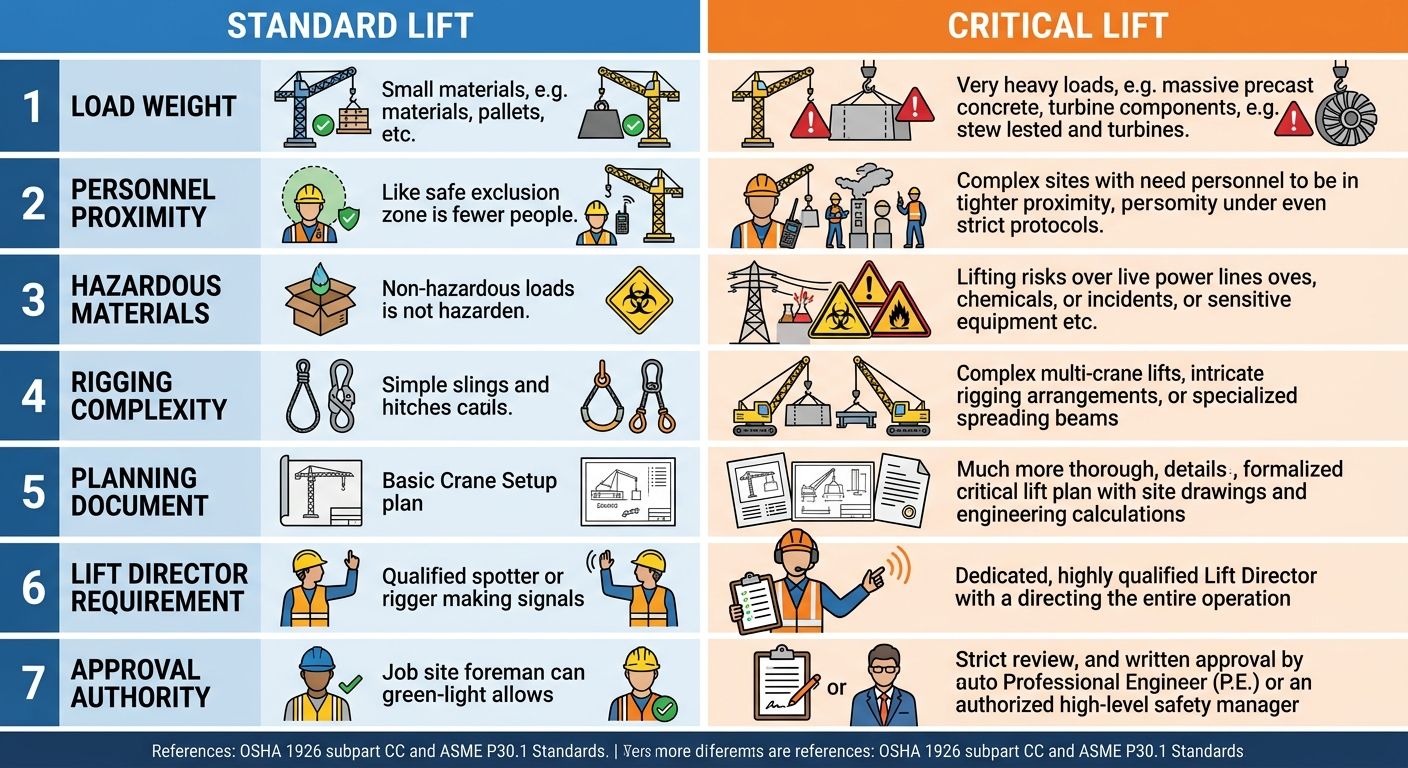
Critical lift vs Standard Lift comparison infographic for crane safety compliance
The infographic above illustrates the seven critical criteria that distinguish a standard lift from a critical lift, from load weight to approval authority. Recognizing when a lift crosses the threshold informs the depth of planning and documentation required. To reinforce these concepts, the table below offers a concise side-by-side comparison.
| Factor | Standard Lift | Critical Lift |
|---|---|---|
| Load Weight Threshold | Below 75% of rated capacity | Exceeds 75% of rated capacity, or any load requiring engineered lift planning |
| Personnel Proximity | No personnel in the fall zone | Personnel are in the fall zone, requiring strict overhead safety protocols |
| Hazardous Material Involvement | No hazardous materials involved | Lift involves hazardous materials (e.g., nuclear, chemical, or explosives) |
| Complexity of Rigging | Simple, single-crane configuration with standard rigging | Multi-crane lifts, tandem lifts, or specialized engineered rigging |
| Required Planning Document | Basic lift plan (often a single checklist) | Formal critical lift plan with engineering approval and detailed procedures |
| Lift Director Requirement | Not required | NCCCO-certified lift director is mandatory |
| Approval Authority | Site supervisor or foreman | Project manager, safety director, and often a registered professional engineer (PE) |
Safety isn’t just a standard — it’s our promise. For a lift planning consultation Chicago tailored to your project, trust our NCCCO-certified team. With the definition and documentation now clear, we next examine the comprehensive planning process.
The ASME P30.1 Standard: Managing Risk from Lift Classification to Execution
To manage lift risk effectively, the industry relies on established standards–chief among them the ASME P30.1 standard. This standard provides a comprehensive framework for developing a critical lift plan that addresses classification, documentation, and execution. By establishing a clear two-tier system of Managed Lifts and Critical Lifts, ASME P30.1 guides project teams in determining the appropriate level of planning rigor and oversight. Understanding how to apply this classification is the first step toward safe, compliant lifting operations.
Understanding Managed Lifts vs. Critical Lifts Under ASME P30.1
ASME P30.1 defines a Managed Lift as a lift with moderate risk, typically performed in a controlled environment with no unusual hazards. A Critical Lift, on the other hand, involves high risk–multiple hazards, potential personnel exposure, or complex rigging arrangements. This classification drives the entire lift planning process, from the depth of engineering review to the qualifications of the personnel involved. OSHA’s definitions in 1926.1401 for terms like qualified person and competent person align with this approach, reinforcing the need for properly credentialed team members.
The following table highlights the key differences between the two classifications:
| Aspect | Managed Lift | Critical Lift |
|---|---|---|
| Risk Level | Moderate risk – controlled environment, no unusual hazards | High risk – multiple hazards, personnel exposure, or complex rigging |
| Engineering Review Requirement | Standard engineering check (e.g., load chart verification) | Full engineered lift plan with PE stamp or equivalent approval |
| Written Procedure | Simplified written procedure or checklist | Comprehensive written procedure with contingency plans |
| Pre-Lift Meeting | Recommended but not mandatory | Mandatory – documented with sign-off from all participants |
| Lift Director Role | Can be a qualified person or experienced operator | Dedicated NCCCO-certified lift director is required |
| Approval Escalation | Site supervision or project manager approval | Multi-level approval including safety director and engineering leadership |
For a Critical Lift, the engineering review must be thorough and often includes a PE stamped plan, while Managed Lifts may only require a standard load chart verification. The pre-lift meeting, which is recommended for Managed Lifts, becomes mandatory for Critical Lifts, with documented sign-off from all participants. This escalation ensures that when hazards increase, the planning and oversight keep pace.
Documentation Requirements for Full Compliance
Full compliance with ASME P30.1 demands a robust set of documents that demonstrate due diligence and risk control. For every lift classified as Critical, our lift planning team ensures that the following items are prepared and maintained:
- Written procedures: A comprehensive lift plan that details step-by-step sequences, roles, and contingency actions.
- Engineered drawings and lift diagrams: Visual representations of crane placement, load path, and rigging configurations, often stamped by a professional engineer for Critical Lifts.
- Equipment certifications: Current inspection records, load test certificates, and manufacturer documentation for all cranes, rigging hardware, and accessories.
- Pre-lift meeting documentation: Signed attendance sheets and meeting minutes that confirm all participants understand their roles and the plan’s safety protocols.
These documents create a chain of accountability and serve as a reference during both the pre-lift meeting and on-site execution. When NCCCO-certified personnel are part of your team, they bring the experience to contribute to and verify these critical documents.
Integrating the Lift Director into the P30.1 Workflow
The lift director is the linchpin of a successful lift under ASME P30.1, especially for Critical Lifts. Lift Director responsibilities include reviewing the lift plan, leading the pre-lift meeting, and maintaining final authority during execution. For Critical Lifts, the standard requires a dedicated NCCCO-certified lift director–not just a qualified person. We provide certified lift director services to meet this requirement, ensuring that a highly trained professional oversees every high-risk lift. Safety isn’t just a standard — it’s our promise, and that promise is reinforced by having a lift director who can halt operations if conditions change or safe execution is compromised.
During the workflow, the lift director collaborates with engineers to validate load calculations, confirms that all documentation is complete, and conducts the mandatory pre-lift briefing. Once the lift begins, the lift director has the authority to stop work if any deviation from the plan is observed, thereby closing the loop between planning and safe execution.
With classification and documentation in place, the next step is ensuring on-site execution aligns with the approved plan.
Building Your Compliant Lift Plan: A Step-by-Step Approach to Job Walkdowns and Safety Protocols
Once you understand the regulatory framework, the next step is building your compliant lift plan. A thorough critical lift plan integrates detailed site assessments, exact equipment matching, and certified team oversight to meet OSHA and ASME standards. By approaching each phase systematically, we help contractors and facility owners in Indianapolis and nationwide achieve safe, efficient lifts while minimizing risk.
Conducting Comprehensive Job Walkdowns and Risk Assessments
A successful critical lift plan begins with an exhaustive job walkdown. Our NCCCO-certified team inspects the site to identify hazards and document conditions that could affect lift stability. As defined by OSHA 1926.1401, a competent person must be capable of recognizing existing and predictable hazards and have the authority to take corrective action. Whether we’re evaluating ground bearing pressure at a Noblesville industrial site or verifying clearance at a Chicago job site, our process ensures no detail is overlooked. During this assessment, we systematically review five key elements:
- Ground bearing pressure to verify that the soil or surface can support the crane and the load
- Overhead power lines and their proximity to the work zone
- Underground utilities that may be damaged by outrigger loads or spoil piles
- Access and egress paths for crane mobilization and emergency response
- Weather constraints, including wind speed, lightning, and visibility
Our experienced field engineers work closely with the project superintendent to finalize the risk assessment. Each finding is recorded in a site-specific checklist that becomes part of the final critical lift plan. This documentation, along with photographic evidence, provides a clear audit trail for OSHA compliance and insurance purposes. After the walkdown, the next phase is to validate crane selection based on the documented conditions.
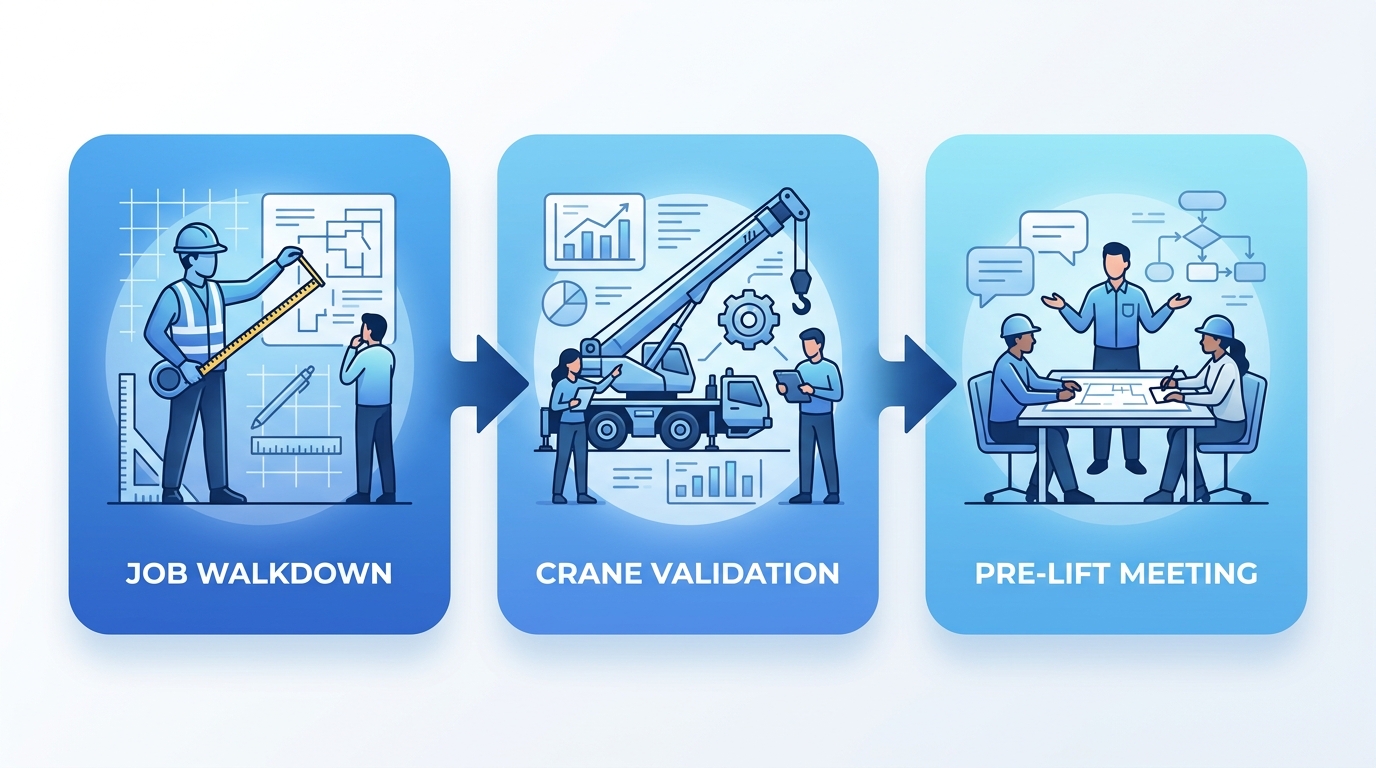
Step-by-step process for building a compliant lift plan
Validating Crane Selection and Load Calculations
After completing your risk assessment, the focus shifts to validating crane selection and load calculations. We match the crane’s rated capacity, maximum lift radius, and outrigger footprint to the load chart, accounting for the weight of the object, rigging hardware, and any dynamic forces. As defined by OSHA, a qualified person must be familiar with the crane’s specifications and limitations. We also integrate the ASME P30.1 standard as a supplementary guide for lift planning, ensuring that all calculations align with industry-recognized best practices. Prior to each critical lift, our lift director validates the load chart against the planned lift radius, jib length, and boom angle. Additionally, we factor in dynamic effects such as wind, swing, and sudden load release. By following the ASME P30.1 standard and applying conservative assumptions, we ensure that the crane operates well within its safe working limits. Load charts from the manufacturer are reviewed to confirm that the lift falls within the crane’s capacity at the intended radius and boom angle. We calculate the total load weight inclusive of all slings, shackles, and spreader bars, and verify that the outrigger spread meets stability requirements. This meticulous matching process minimizes the risk of overload, tip-over, or structural failure.
We apply this same rigorous matching process to every project, including our hospital expansion lift services at a facility in Avon, Indiana. At Crane Industry Experts, we deliver safe, professional, and reliable crane and rigging solutions that keep your project on schedule and compliant.
Coordinating with NCCCO-Certified Personnel for On-Site Oversight
With the crane validated, the final step is assembling the right team. A critical lift demands a coordinated group of NCCCO-certified professionals, each with distinct duties and required endorsements. Our nationwide deployment network ensures we can supply certified personnel — from Sioux Falls to Cedar Rapids, or anywhere across the U.S. The table below summarizes the key roles and their certifications.
| Role | Primary Duty | Required Certification(s) |
|---|---|---|
| Lift Director (LDO) | Overall lift operation safety, coordinates lift plan and site personnel | NCCCO Lift Director endorsement (LDO) |
| Crane Operator | Safe operation of the crane, following lift director signals | NCCCO certification specific to crane type (e.g., TSS, LAT, TLL) |
| Rigger Level II (RII) | Complex load attachment, hitch configurations, and load securing | NCCCO Rigger Level II certification (RII) |
| Signalperson | Clear and standard communication (hand signals/radio) with the operator | NCCCO Signalperson certification (CSP) |
The Lift Director responsibilities include overall lift operation safety, coordinating the plan and site personnel, and leading the pre-lift meeting. During that meeting, the team reviews the critical lift plan, communicates hazards, outlines emergency procedures, and confirms that the Lift Director has the authority to stop work if conditions change. This meeting ensures alignment on the step-by-step sequence of the lift, emergency stop signals, and the location of safety zones. The Crane Operator maintains constant communication with the signalperson and must hold an NCCCO certification matching the crane type, such as TSS for telescopic boom or LAT for lattice boom crawler cranes. The Signalperson uses standard hand signals or radio communication to guide the operator, and the Rigger Level II ensures complex hitches and load attachment points are secure. Every team member is trained to recognize and respond to unsafe conditions immediately.
For every project, we stand by the principle that safety isn’t just a standard — it’s our promise. From pre-lift planning to final placement, our certified team manages every aspect of the lift with the highest safety standards. With a compliant lift plan and a certified team in place, your critical lift operation is poised for a safe and efficient execution.
Multi-Crane Lifts and Complex Rigging: Advanced Compliance Strategies for High-Risk Operations
Multi-crane lifts and complex rigging operations introduce exponential risk compared to single-crane work. Each additional crane demands rigorous coordination, and a well-structured critical lift plan is the foundation of multi-crane safety. When heavy loads must be shared across two or more cranes during high-stakes projects, clear authority and compliance with OSHA standards are non-negotiable.
Under OSHA’s 1926.1400 standard, all power-operated cranes in construction–including tower, mobile, and crawler configurations–fall within the scope of Subpart CC. This regulation mandates that employers establish and enforce work rules for every lift, regardless of complexity. Within this framework, OSHA’s 1926.1401 definitions provide essential clarity, distinguishing a competent person (someone capable of identifying hazards and authorized to act) from a qualified person (someone with recognized credentials or experience). For multi-crane operations, the lift director assumes overarching authority for the entire operation, while the crane supervisor executes the plan for a specific crane. This division is critical for safety.
In practice, the lift director leads the pre-lift walkdown, creates the critical lift plan in alignment with the ASME P30.1 standard, and retains the final say on any safety concern. The crane supervisor, while not authorized to halt the entire lift, ensures the assigned crane operates within its load chart and that the operator receives correct signals. Understanding Lift Director responsibilities is essential to avoid overlapping commands, which can cause costly delays or accidents. By separating these roles, projects maintain clear lines of communication and accountability.
High-risk environments such as power plant outages demand this level of structured oversight. Industries such as power generation rely on our power plant outage lift services to manage complex rigging under tight timelines. Our NCCCO-certified lift directors and crane supervisors, based in Indianapolis, deploy nationwide to deliver safe, professional, and reliable crane and rigging solutions that support your project’s success — start to finish. Safety isn’t just a standard — it’s our promise.
Frequently Asked Questions About Critical Lift Plans and Lift Director Responsibilities
Below are answers to frequently asked questions about these standards.
What is a critical lift plan?
A critical lift plan is a detailed document required by OSHA 1926.1400 for any lift exceeding 50% of the crane’s rated capacity, involving multiple cranes, or presenting unusual hazards.
What are the Lift Director responsibilities?
Lift Director responsibilities include developing the critical lift plan, overseeing its execution, and ensuring compliance with OSHA regulations and the ASME P30.1 standard. This role requires a qualified person, and our NCCCO-certified lift directors deliver safe, professional, and reliable crane and rigging solutions.
How do OSHA standards apply to critical lift planning?
OSHA 1926.1401 defines key terms such as competent person, qualified person, and lift director. A lift director must be a qualified person capable of identifying and mitigating hazards. For a detailed example, see our case study on municipal well system lift planning.
Partnering with NCCCO-Certified Experts to Elevate Project Safety and Efficiency
Partnering with NCCCO-certified experts ensures safety and compliance in every critical lift plan we develop. OSHA 1926.1400 mandates qualified operators, riggers, and signalpersons, and our teams exceed these requirements.
Our Lift Directors shoulder all Lift Director responsibilities, from site walkdowns to load verification, in full alignment with the ASME P30.1 standard and OSHA’s definitions of competent and qualified persons. This integrated approach cuts incidents and downtime while speeding project timelines.
With nationwide availability, we mobilize certified teams fast, ensuring your project stays fully compliant and on schedule.