Table of Contents
Understanding NCCCO Lift Director Certification and Its Importance in Crane Safety
NCCCO lift director certification is a specialized credential that validates an individual’s expertise in overseeing crane lifts safely. According to the National Commission for the Certification of Crane Operators (NCCCO), this certification is distinct from operator or rigger credentials because it focuses on the full lifecycle of a lift — from initial critical lift planning and site assessment to execution and closeout. A certified lift director understands load charts, personnel coordination, and risk mitigation, ensuring that even the most challenging lifts proceed smoothly. On projects across the U.S., OSHA standards and the ASME P30.1 standard often mandate a qualified individual to direct complex lifting operations, and the NCCCO lift director certification confirms that competency. By integrating comprehensive critical lift planning with on-site leadership, the lift director becomes the cornerstone of crane safety. When every load matters, the presence of a certified professional ensures that safety isn’t just a standard — it’s our promise.
Before You Begin: Eligibility and Preparation for Lift Director Certification
Before you can earn your lift director certification, it’s essential to understand the prerequisites and how to prepare. Understanding these requirements helps you approach the process confidently and efficiently.
To earn lift director certification, candidates must meet the National Commission for the Certification of Crane Operators (NCCCO) eligibility requirements. NCCCO mandates a minimum of two years of documented experience in crane operations, rigging, or a closely related field. Candidates must also demonstrate knowledge of ASME P30.1 standards for safety-first lift planning and pass both the NCCCO-written and practical exams. Gathering documentation of training hours and work experience well before applying is strongly recommended.
Preparation efforts should focus on studying the official NCCCO candidate handbook and reviewing key areas such as critical lift planning and safety protocols. Developing a solid study schedule and considering preparatory courses from recognized training providers can further strengthen your readiness. Recertification is required every five years, so maintaining current knowledge is essential.
For complex lift planning or to enhance your readiness, consulting a rigging consultant can provide valuable support. Whether you are pursuing initial certification or recertification, our experienced team can guide you through the process. Our team of NCCCO-certified personnel is ready to assist with your project needs.
Meeting the Eligibility Prerequisites for NCCCO Lift Director Certification
Once you understand the value of certification, the next step is meeting the eligibility prerequisites defined by the National Commission for the Certification of Crane Operators (NCCCO).
Instructions
- Verify your crane-related experience meets the 1,000-hour threshold.
- Enroll in an NCCCO-recognized lift director training course.
- Register for the NCCCO Lift Director written exam.
- Gather documentation (verification letters and training certificates).
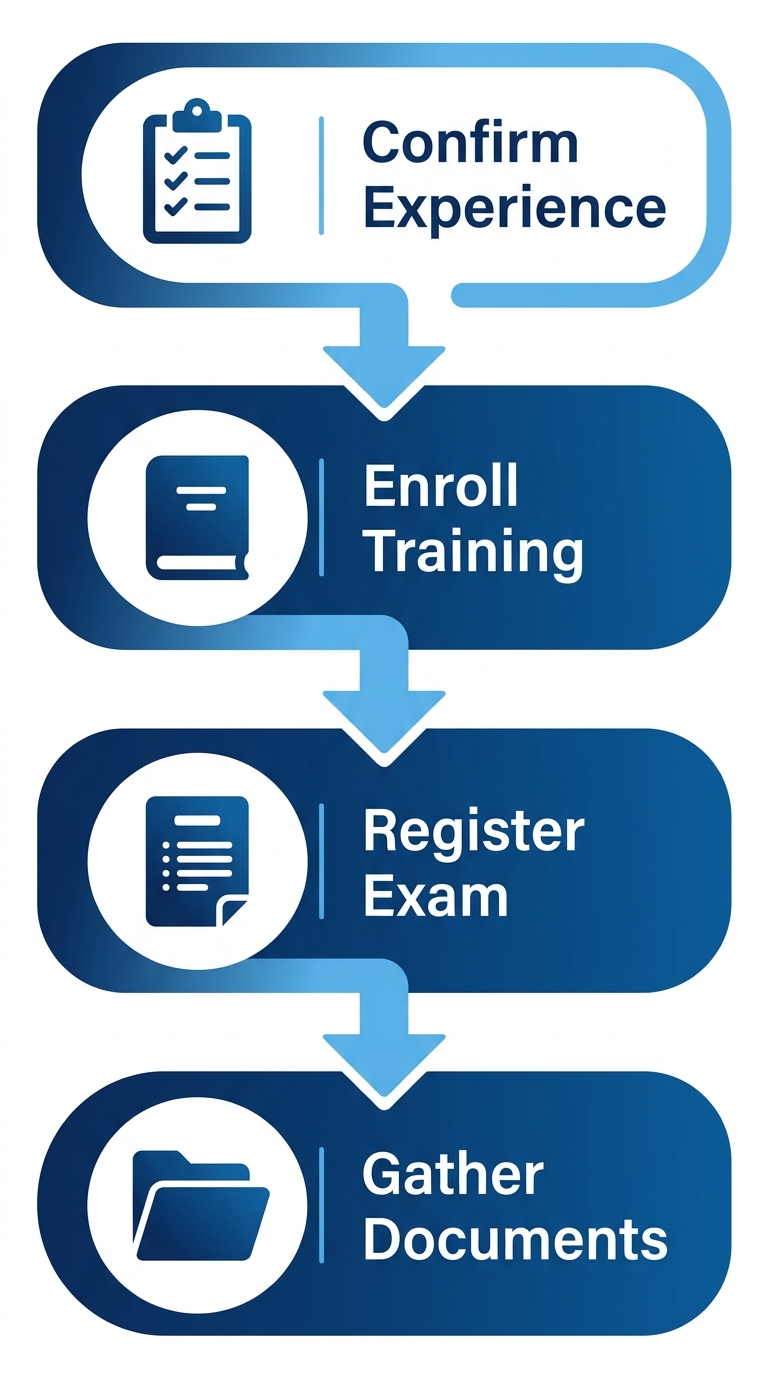
Four-step eligibility process for NCCCO Lift Director certification.
Why It Matters
The lift director certification prerequisites place safety at the forefront. The experience requirement ensures you have hands-on familiarity with crane dynamics and site hazards. Accredited training covers ASME P30.1 standards for lift planning, while the exam validates critical lift planning and safety knowledge. Safety isn’t just a standard — it’s our promise.
Tips
Contact NCCCO to confirm the latest requirements; keep a logbook of your operating hours; verify that your training provider is NCCCO-accredited. For help verifying your experience or enrolling in training, explore our comprehensive lift director services nationwide.
After confirming you meet these prerequisites, proceed to the application process.
Completing Formal Training and Exam Study for the Lift Director Exam
Once you understand the prerequisites, the next step is completing formal training and focused exam study.
Instructions
When pursuing lift director certification, formal training provides the foundation for success. Start by visiting the NCCCO website to identify accredited programs and exam blueprints. According to the NCCCO, courses cover ASME P30.1 standards, OSHA regulations, and critical lift planning principles. Choose an NCCCO-accredited program and set aside 3-6 months for structured study, with weekly review sessions and practice exams.
Why It Matters
Earning your lift director certification through structured study ensures you can manage critical lift planning scenarios confidently. Our certified rigging services, delivered by NCCCO-certified personnel, combined with lift director training, support full-spectrum lift safety. This safety-first commitment protects both personnel and project outcomes.
Tips
To maximize your study efforts:
- Bookmark NCCCO study guides and review them weekly.
- Practice load chart interpretation with real scenarios.
- Take timed NCCCO practice exams to build confidence.
- Join a study group to discuss topics and share resources.
Passing the NCCCO Lift Director Written Examination
Once you understand the certification requirements, the next step is passing the written exam for lift director certification.
Instructions
According to NCCCO, the Lift Director Written Examination is a multiple-choice test comprising 50 questions, with a one-hour time limit. The content areas include load charts, rigging, crane setup, critical lift planning, safety regulations, and ASME P30.1 standards. A passing score of 80% or higher is required. We recommend studying the NCCCO Lift Director Candidate Handbook and the ASME P30.1 standard to prepare thoroughly.
Why It Matters
This written exam validates the theoretical knowledge essential for safe lift direction. Passing it confirms that lift directors understand critical planning, safety regulations, and can apply them to protect crews and equipment. Safety isn’t just a standard – it’s our promise.
Tips
Manage your time by reading each question carefully, eliminating incorrect answers, and flagging difficult items for review. Practice with sample questions and focus on weak areas. Consider consulting with crane safety consultants for additional study resources and practical exam preparation.
Demonstrating Skills in the Practical Examination for Lift Director Certification
After meeting the knowledge requirements of the written exam, the lift director certification process advances to a hands-on practical examination that evaluates real-world competence.
Instructions
Upon arrival at the test site, you will conduct a pre-lift briefing with the crew to review roles and safety protocols. Next, inspect the equipment thoroughly per NCCCO guidelines. Then, develop a lift plan that adheres to ASME P30.1 standards and incorporates critical lift planning. You must rehearse hand and radio signals until clear, then execute the lift while examiners observe your coordination. Finally, participate in a post-lift debrief to discuss performance. Evaluators assess signal clarity, plan adherence, safety compliance, and situational awareness.
Why It Matters
Hands-on testing validates that a certified lift director can manage real-world risks and distinguish themselves from untrained personnel. This evaluation reinforces the NCCCO certification importance, as it confirms the ability to apply knowledge under pressure and reduce onsite hazards.
Tips
To excel, rehearse standard hand and radio signals until they become automatic. Review the lift plan template and perform a site walkthrough to familiarize yourself with the layout. Stay calm under observation–examiners look for confidence and a systematic approach. We recommend practicing these steps well before exam day.
Understanding Lift Director Responsibilities Under ASME P30.1
A lift director certification through NCCCO validates the expertise needed to oversee complex lifts under ASME P30.1 standards. Under these standards, certified professionals bear specific, documented responsibilities that form the backbone of safe crane operations. We deliver safe, professional, and reliable crane and rigging solutions by ensuring every lift director we deploy fully understands and executes these duties.
Instructions
The lift director’s core duties follow a clear sequence. First, develop and approve a detailed lift plan per ASME P30.1 Section 3. Next, verify that all NCCCO-certified personnel–crane operators, riggers, and signalpersons–hold current certifications. Then, conduct pre-lift meetings and hazard assessments, confirming all safety equipment is in place. The lift director must also be designated in writing and has the authority to stop any lift that is unsafe, per OSHA 1926.1400 subpart CC. For critical lift planning, the lift director determines if engineered lift plans and additional safety measures are required.
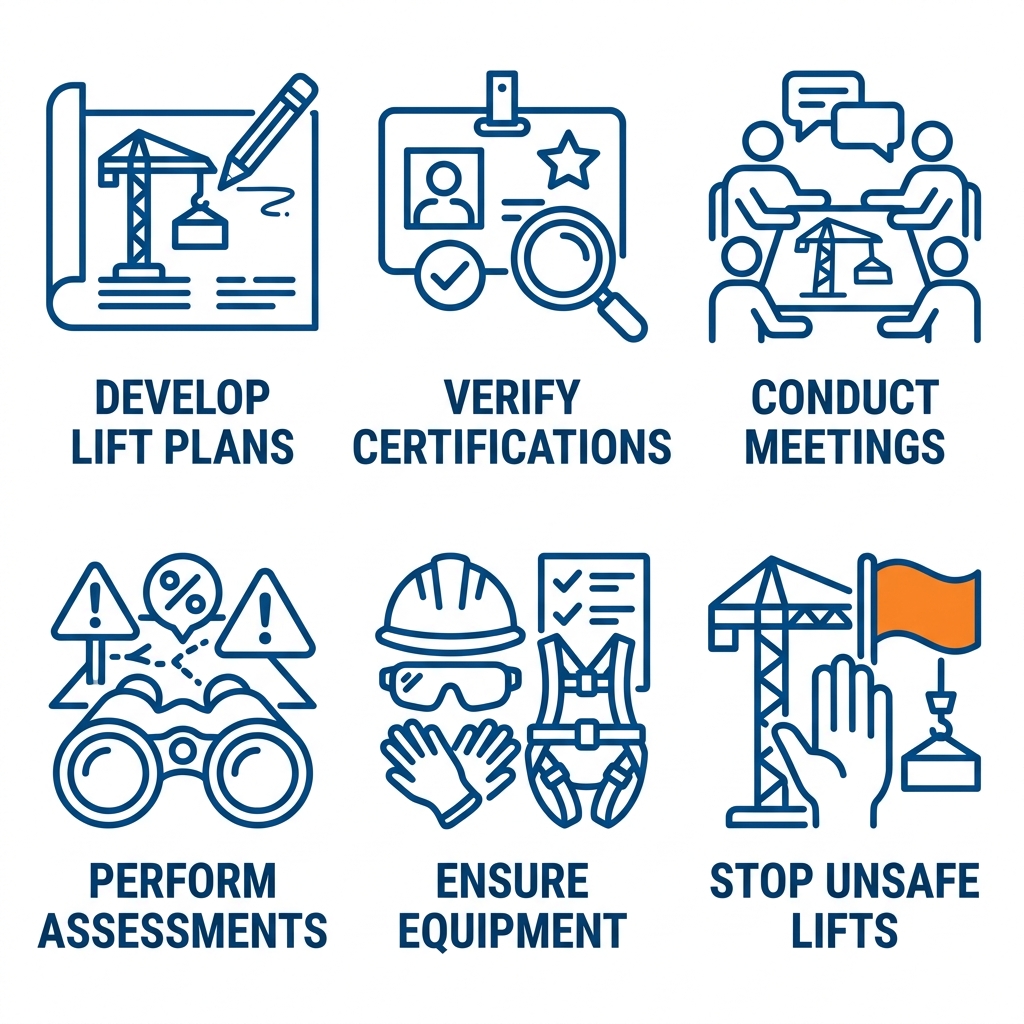
Core lift director responsibilities under ASME P30.1
Why It Matters
These responsibilities directly ensure safety, regulatory compliance, and project success. As the Occupational Safety and Health Administration (OSHA) framework and ASME P30.1 requirements make clear, the lift director role is the central safeguard against catastrophic failure. Safety isn’t just a standard — it’s our promise.
Tips
- Use standardized checklists to document every step of the lift plan and personnel verification.
- Hold brief coordination huddles with your team immediately before the lift to reinforce signals and roles.
Applying Critical Lift Planning Principles as a Certified Lift Director
At Crane Industry Experts, we translate certification knowledge into actionable, on-site safety. Our Certified Lift Directors follow a structured methodology for every high-risk project, beginning with a clear assessment of lift criteria — such as loads exceeding 75% of crane capacity, multiple-crane lifts, or proximity to power lines — as defined by ASME P30.1.
Instructions
Our five-step critical lift planning process turns complexity into control. We start by assessing load characteristics and calculating weight and center of gravity. Next, we determine crane configuration and rigging requirements. The plan is then documented with detailed controls before we communicate every step with the lift team:
- Assess load characteristics (weight, center of gravity, dimensions).
- Calculate total load; verify it against crane capacity charts.
- Determine crane configuration, boom angle, and rigging selection.
- Document risk controls, including power line clearance and ground stability.
- Communicate the plan to the operator, riggers, and signalperson.
Why It Matters
Thorough planning is the backbone of risk reduction. A Certified Lift Director applies lift director certification training to reduce accident risk by up to 70%, while ensuring full compliance with OSHA 1926 Subpart CC and ASME P30.1 standards for load control documentation.
Tips
To execute a safe lift, we integrate critical lift planning checklists into our daily workflow. Our NCCCO-certified lift directors use a pre-lift checklist covering equipment inspection, weather limits, and operator credentials. Involving the entire lift team in the plan review catches errors before execution, and we keep the documented plan on-site for the entire duration of the lift.
Now that we understand the planning framework, we deliver these principles through our on-site lift director services.
Maintaining Your Lift Director Certification and Planning for Renewal
Once you have earned your lift director certification, the next step is keeping it active. Maintaining your lift director certification requires planning, and we recommend starting well before your expiration date.
Instructions
The National Commission for the Certification of Crane Operators (NCCCO) requires renewal every five years. The two main paths are:
- Continuing education: Complete 16 hours of NCCCO-approved coursework related to crane and rigging operations.
- Re-examination: Pass the written and practical exams again, typically required if certification lapses beyond the grace period.
When you prepare your renewal package, log all supervised lift hours and formal training. Without timely renewal, the certification lapses and you must retake the full exam.
Why It Matters
Staying current with ASME P30.1 standards for lift planning is essential for compliance and safety. Keeping your lift director certification current demonstrates professional commitment and opens doors to advanced roles in critical lift planning.
Tips
Track your expiration date on a calendar and use NCCCO’s online portal for alerts. Keep a digital folder of certificates and course completions so your documentation is ready when renewal is due.
With your certification secure, you can confidently lead critical lifts and support your project’s success.
Troubleshooting Common Challenges in Lift Director Certification
Even with a clear roadmap, candidates often encounter specific roadblocks when pursuing lift director certification. From meeting the rigorous experience requirements to navigating the exam’s technical content, understanding these hurdles is the first step toward overcoming them. We regularly guide professionals through these common challenges, helping them achieve their credentials efficiently.
Experience documentation is a frequent stumbling block. The National Commission for the Certification of Crane Operators (NCCCO) mandates candidates demonstrate 1,000 documented hours of lift director experience within the past five years. We recommend maintaining a meticulous daily log that records project names, dates, and your specific responsibilities, as this serves as indisputable proof during the application review.
Role confusion between a lift director and a crane operator is another common pitfall. Under ASME P30.1 standards, a lift director is responsible for the entire lift’s planning and execution, not just the equipment’s operation. This oversight role includes verifying the lift plan, ensuring personnel are qualified, and confirming that all site conditions remain safe–a scope of work far broader than operating the crane.
Exam preparation poses a significant challenge, as the NCCCO written exam covers detailed regulations like ASME B30.5 and OSHA’s 1926 Subpart CC. Your study strategy should focus on the NCCCO’s own reference manuals, which are directly aligned with the test’s technical content and regulatory framework.
Recertification procrastination can also cause credentials to lapse. The five-year cycle requires both a written exam and, in some cases, a practical demonstration. We advise setting calendar reminders a year in advance and enrolling in refresher courses early to stay ahead of deadlines.
For many, mastering critical lift planning is the most technically demanding challenge. Practicing with standardized templates and on-site scenarios helps inexperienced lift directors develop a methodical approach that meets ASME P30.1 compliance. By anticipating these obstacles, our NCCCO-certified personnel help clients navigate the certification process smoothly, ensuring their projects always uphold the highest safety standards.
Elevate Your Career with NCCCO Lift Director Certification
Earning your lift director certification from NCCCO positions you as a recognized expert in critical lift planning and field execution. This credential demonstrates mastery in load chart interpretation, crew coordination, and developing lift plans that satisfy the rigorous personnel qualification mandates under OSHA 1926.1400 and ASME P30.1 standards. As an NCCCO-certified lift director, you become eligible to lead complex heavy-lift projects where general contractors, EPCs, and facility owners require documented oversight.
The National Commission for the Certification of Crane Operators (NCCCO) validates this advanced competency through a written examination and a practical demonstration, ensuring every certified professional can plan, communicate, and manage high-risk lifts safely. Holding the lift director designation lets you command higher-responsibility assignments and premium project roles across the United States. Our NCCCO-certified personnel understand that safety isn’t just a standard — it’s our promise, and our certified lift directors are ready to lead your most complex lifts.